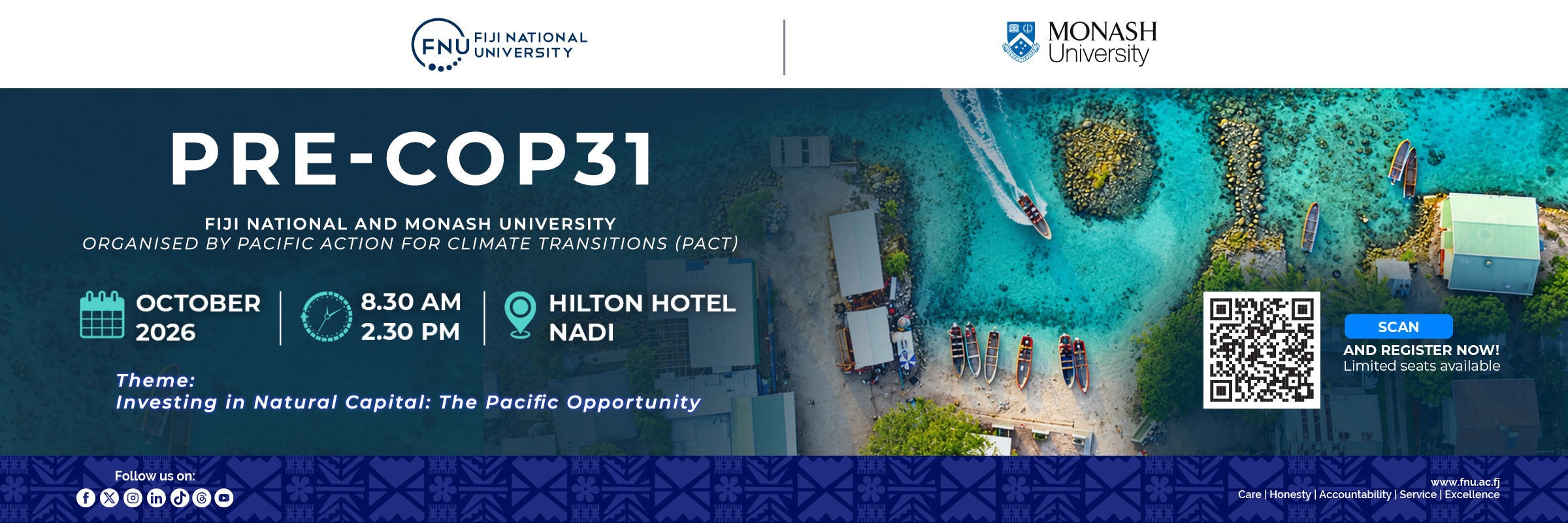
A PACT Pre-COP31 event hosted by Fiji National University
The Pacific is home to some of the world’s most significant natural assets — vast ocean territories, tropical forests, coral reefs, mangroves, and freshwater systems that sustain communities, underpin food security, and provide critical buffers against climate impacts. These ecosystems remain chronically undervalued in global climate finance, and the Pacific receives a fraction of the investment its natural capital warrants.
Water is the thread that runs through this natural wealth. For Pacific communities the climate crisis is, in practice, a water crisis: water is the primary medium through which climate’s threats reach health, food security and livelihoods. Disruptions to the water cycle — extreme rainfall, drought and sea-level rise — fall hardest on the poor and vulnerable. Investing in natural capital and managing water wisely are therefore two faces of the same opportunity: protect and value the ecosystems, and the water systems that flow through them, and Pacific communities and their environments can thrive together.
As the world moves toward COP31 in Antalya, the Pacific’s blue and green natural capital — and the water systems it holds — represents a significant opportunity for private investment, sustainable revenues, and measurable climate, biodiversity and health outcomes. Of the billions committed annually through international climate funds, Pacific Island countries receive only a small proportion. Closing that gap requires innovative investment structures, capable local institutions, and pathways to public funds and private capital markets.
This event, hosted by Fiji National University and organised through PACT (the FNU–Monash joint centre), brings together traditional leaders, financiers, policymakers and community practitioners to move beyond conversations about the Pacific’s vulnerability and towards partnerships and investable opportunities that can be carried to COP31.
More than 80% of Fiji’s natural resources belong to the indigenous people, and their customary custodians are the chiefs. Any credible conversation about investing in Pacific natural capital — land, forests, reefs, fisheries and water — must therefore be grounded in the authority and stewardship of traditional leaders. This event places that custodianship at its heart, not as ceremony alone but as the foundation on which partnerships, investment and water management are built.
Accordingly, Tui Macuata Ratu Wiliame Maivalili Katonivere opens the day as Chief Guest with a welcome and opening remarks, and the Chair of the Great Council of Chiefs, Ratu Viliame Seruvakula, joins the partnerships panel to speak to traditional leadership and its role in the stewardship of Pacific natural capital. Chiefly voices sit at the heart of the substantive discussion, ensuring that Pacific leadership, knowledge and management of Pacific ecosystems frame the conversation about outside capital rather than the reverse.
The day’s closing address is delivered by the Prime Minister of Fiji, Hon. Sitiveni Ligamamada Rabuka.
The event is designed to deliver: