
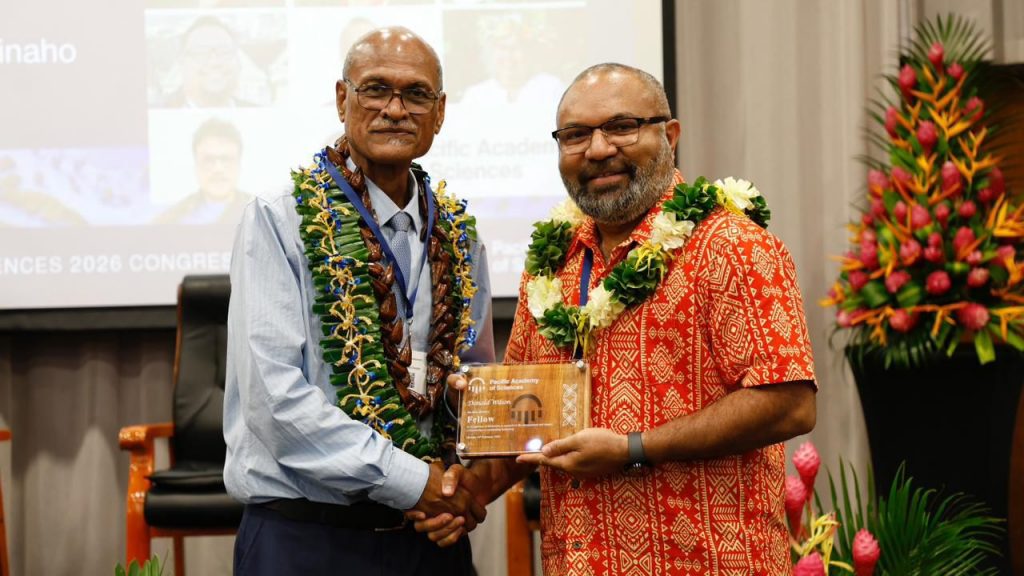
Dr Donald Wilson (right) receiving his fellow plaque from the PAS President Professor Teatulohi Matainaho
The Fiji National University (FNU) proudly celebrates the induction of Associate Professor Donald Wilson as a Fellow of the Pacific Academy of Sciences. A milestone that signals the growing influence of Pacific-led research in shaping global scientific dialogue.
As the first Fellow from FNU, Associate Professor Wilson described the honour as both humbling and deeply significant for the region.
“Being inducted as a Fellow of the Pacific Academy of Sciences represents recognition of a broader movement and the strengthening of Pacific-led scientific leadership,” he said.
“Professionally, it signals that research emerging from Fiji and the wider Pacific can shape global conversations on health, climate, and development. I see this not as an endpoint, but as an opportunity to elevate FNU and the Fiji Institute of Pacific Health Research (FIPHR) as regional hubs for integrated, systems-based research.”
The Fellowship acknowledges Associate Professor Wilson’s sustained contributions to strengthening research ecosystems across Fiji and the Pacific. His work integrates infectious disease surveillance, planetary health, sexual and reproductive health, maternal and child health, and non-communicable disease research within a comprehensive systems framework.

Pacific Academy of Science Fellowship members
Through regional collaborations, laboratory strengthening, health workforce development, and integrated surveillance platforms, his research has consistently focused on ensuring Pacific science remains policy-relevant, equity-driven, and responsive to the region’s health, climate, and environmental challenges.
He credits FNU as central to his professional journey and the advancement of medical science in the region.
“FNU has been pivotal. Through leadership roles within the College of Medicine, Nursing and Health Sciences (CMNHS) and the Fiji Institute of Pacific Health Research, we have worked to embed research within education, clinical services, and community engagement,” Associate Professor Wilson said.
“FNU’s support has enabled us to move beyond project-based research towards institutional research capacity — building laboratories, strengthening research training, mentoring young scientists, and fostering partnerships aligned with Fiji’s National Development Plan 2050, the 2050 Blue Pacific Strategy, and Sustainable Development Goal 3.” Associate Professor Wilson emphasised that Pacific island nations face some of the most pressing global challenges, including climate change, infectious disease threats, and escalating non-communicable diseases. He believes Pacific-led research is critical to shaping effective and sustainable policy responses.
“When evidence is generated locally, it strengthens ownership, improves policy uptake, and builds trust between communities, governments, and researchers,” he said.
“A planetary health lens, recognising the interconnection between environmental systems and human health, will be essential in shaping the next generation of Pacific health policy.”
In a message to emerging researchers and healthcare professionals, he encouraged young Pacific scholars to pursue excellence without compromising their regional identity.
“Do not view international excellence and Pacific identity as separate ambitions; they are complementary. Our region holds some of the most urgent research questions in global and planetary health,” he said.
“Pacific science is no longer peripheral to global conversations; it is essential to them. Our region is not just vulnerable; it is innovative, resilient, and capable of generating solutions the world can learn from.”
The Fellowship reflects the FNU’s ongoing commitment to strengthening research leadership, building institutional capacity, and positioning Fiji and the Pacific as active contributors to global scientific advancement.