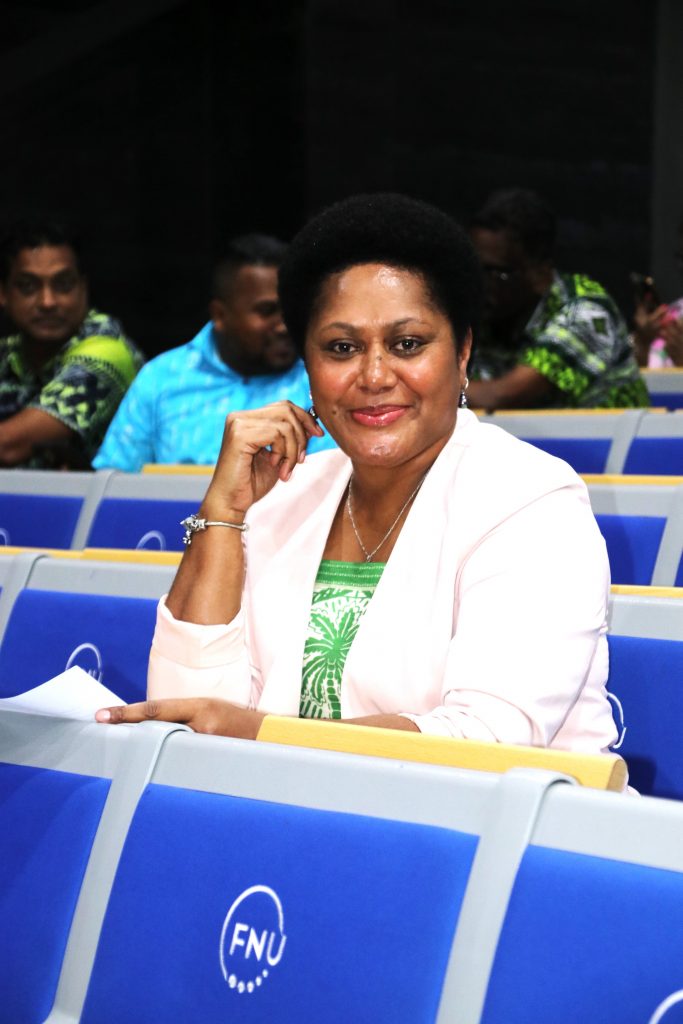
Dr Kasanita Nayasi.
The Fiji National University’s (FNU) Assistant Professor at the College of Humanities, Education and Law (CHEL), Dr Kasanita Nayasi is placing a strong focus on phonemic awareness in the iTaukei language.
A recent lecture in the unit, EDU553: Language Study 1 at the FNU’s Natabua Campus in Lautoka to first-year students undertaking the programme Bachelor of Education (Primary), offered a powerful, and deeply human, response ‘we must return to the basics and get them right’.
Dr Nayasi said the question of why some children remained non-readers continued to weigh heavily on educators.
Focusing on phonemic awareness in the iTaukei language, her lecture challenged a common assumption; ‘that because a language is spoken, it is easily taught’.
She said in reality, learning to read in one’s mother tongue required careful and intentional teaching, and the understanding of how sounds work, how words are formed, and how children learn.
“At the heart of the lecture was a simple but transformative idea – start where the child is. Many young children already know sounds like n, t, m and p and syllables like na, ta, ma, and pa through words like nana, tata, mama and papa. These are not small beginnings; they are powerful entry points into literacy. By building on what children already know, reading becomes less intimidating, more meaningful, and deeply connected to their world,” shared Dr Nayasi.
“Rather than teaching the alphabet rigidly from A to Z, a structured seven-group phonics approach (drawing on principles similar to Jolly Phonics, but adapted to the iTaukei language context) refined through 2 years of practice – guides learners from simple, familiar sounds to more complex patterns. It is practical, culturally grounded, and effective.”
She said however, the lecture was not just about children but also about teachers.
Dr Nayasi added that student-teachers quickly realised that speaking a language was not the same as teaching it.
“They must learn the science of language – grammar, phonology, morphology, and syntax structures, and the art of bringing it to life in the classroom. They are challenged to create, adapt, and teach with purpose.”
She added that in the weeks to come, the lecture would focus on equipping students with the skills to design and develop their own teaching resources, including songs, movement-based activities, and other interactive materials, enabling them to confidently implement these in classroom settings, while also fostering the creation of effective and engaging learning environments.
“The message is clear and urgent: if we strengthen literacy in the mother tongue, we build the foundation for bilingual success. If we support this learning at home and in our communities, we change outcomes,” she added.
Dr Nayasi equally highlighted that in line with this, the work at the FNU was already underway.
“When we get the basics right, every child has a chance to read and to thrive,” she said.