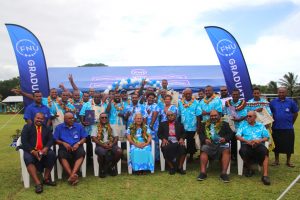
For the first time, the Class 6 Master and Engineering Full License Certificate of Competency has been introduced in Rewa, with 19 students graduated on Friday after successfully completing a one-month training programme.
The programme was launched in Nukui Village, Rewa, and comprised a comprehensive training schedule: three days of basic sea survival training, three weeks of nautical knowledge, and one week of engineering knowledge.
This initiative was delivered through the Fiji National University’s (FNU) Pacific Centre for Maritime Studies (PCMS) and sponsored by the Pacific-European Union Marine Partnership (PEUMP) Programme.
Sevuloni Valenitabua expressed his gratitude for being among the 19 graduates.
“I am extremely happy to be one of those who graduated. This is the first certificate that bears my name. I would like to sincerely thank the sponsors—without their support, we would not have been able to participate in this programme,” he said.
“We are truly grateful. I also wish to thank FNU for making it more accessible by coming to the village.
The lecturers made the learning process easier for us to understand. Many of us needed this certificate, but due to financial constraints, we were previously unable to pursue it.”
Head of the Nautical Department at the Pacific Centre for Maritime Studies (PCMS), Captain Vilivo Valenitabua, said Nukui Village was fortunate to be able to access funding support from the University of the South Pacific (USP).
“The role of FNU’s PCMS is to serve as the training institution. For this programme, we assigned two lecturers who delivered a comprehensive training schedule to the participants,” Captain Valenitabua said.
“The Maritime Safety Authority of Fiji (MSAF) facilitated the issuance of the Class 6 Certificate of Competency (COC), which the participants received today. Nukui Village was in contact with USP, which had the necessary funds to support the programme. Once initial discussions began, USP informed us that they required sufficient participant numbers as well as approval from MSAF before proceeding.”
He added that Nukui Village was able to meet the required number of participants, which was then submitted to MSAF to allow the course to go ahead.
“This programme needs to be rolled out across Fiji, but the main challenge is securing funding. Nukui Village was fortunate to be able to access support through USP, which made this training possible,” Captain Valenitabua said.
USP Officer-in-Charge for the Centre for Sustainable Futures, Dr Isoa Korovulavula, said the PEUMP Programme was implemented by several partners, including the Pacific Community (SPC), the Forum Fisheries Agency (FFA), the Secretariat of the Pacific Regional Environment Programme (SPREP), and USP.
“One of the activities under the USP-PEUMP objective is the development of ‘Lifelong Learning Pathways’ for marine and fisheries stakeholders, which includes continuing professional development
opportunities. This also involves providing financial support through scholarships for individuals from low-income households to address the challenges of poverty,” Dr Korovulavula said.
Dr Korovulavula added that the graduates from Nukui Village will now meet the Maritime Safety Authority of Fiji (MSAF) requirements for all boat owners.
“They will also be permitted to operate their boats outside the reef areas, enhancing opportunities for both livelihoods and employment. Furthermore, their Master/Engineer Class 6 Certification will enable them to access Fish Aggregating Devices (FADs) being installed by the Ministry of Fisheries outside the reef areas,” he said