
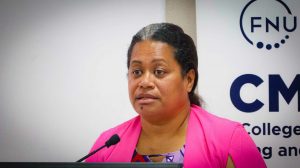
The Acting Dean of College of Medicine, Nursing and Health Sciences, Dr Amelia Turagabeci.
Want a career where your knowledge and skills, can make a real difference in people’s lives? The Fiji National University’s (FNU) College of Medicine, Nursing and Health Sciences (CMNHS), offers several pathways to turn that ambition into a profession.
From nutrition and environmental health to disease prevention, health promotion and healthcare management, students can choose from a range of programmes that prepare them to contribute to the health and wellbeing of people across Fiji and the Pacific.
Prospective students interested in these opportunities, are encouraged to apply for Semester 1, 2027, before applications close on 30 November 2026.
Among the programmes on offer are five undergraduate qualifications delivered by the College’s School of Public Health and Primary Care (SPHPC), and they are, the Bachelor of Dietetics and Nutrition, Bachelor of Environmental Health, Bachelor of Health Promotion, Bachelor of Health Services Management and Bachelor of Public Health.
The Acting Dean of CMNHS, Dr Amelia Turagabeci, said public health and primary care were increasingly important as Fiji and other Pacific Island countries responded to growing and complex health challenges.
“Many of the health challenges facing Fiji and the Pacific cannot be addressed through hospital treatment alone. They require prevention, early detection, community engagement, health education and strong primary healthcare systems.”
“Public health is about looking beyond individual illnesses and understanding the wider factors that influence people’s health, including their living conditions, access to nutritious food, education, environment and socioeconomic circumstances,” Dr Turagabeci said.
She highlighted the continuing burden of non-communicable diseases (NCDs), including diabetes, cardiovascular diseases, hypertension, cancer and obesity, across the region.
Public health professionals play an important role in responding to these challenges through disease prevention, screening, health education and community-based interventions. They also contribute to communicable disease control through surveillance, outbreak investigations, immunisation promotion and public awareness.
Dr Turagabeci added that strong primary healthcare systems, were equally important in ensuring people, particularly those in rural communities, remote islands and vulnerable populations, could access essential health services closer to home.
“Strong primary healthcare systems ensure that people can access essential health services closer to where they live. It is also important that we develop professionals who understand the unique cultural, social and environmental contexts of our Pacific communities,” she further stated.
Each of the five programmes offers a different area of specialisation and opens pathways into a range of health-related careers. As quota-based programmes, they can accommodate only a limited number of students.
The Bachelor of Dietetics and Nutrition prepares students to assess nutritional needs and develop interventions for individuals, families and communities, including addressing malnutrition and diet-related diseases.
The Bachelor of Environmental Health focuses on identifying and managing environmental risks to public health, with areas of study including sanitation, water quality, food safety, waste management, occupational health and environmental protection.
The Bachelor of Health Promotion equips students to encourage healthier behaviours through health education, advocacy and targeted community interventions.
The Bachelor of Health Services Management develops leadership, planning and administrative skills needed to coordinate healthcare delivery and improve the operations of health organisations.
The Bachelor of Public Health provides a broader understanding of population health, with key areas of study including epidemiology, community health, research, disease surveillance and health policy.
Dr Turagabeci also highlighted that students would gain academic, technical, analytical, communication and practical skills throughout their studies, preparing them to respond to real health needs in their communities and workplaces.
These include interpreting health data, conducting research, understanding the factors that influence health, planning and evaluating interventions, engaging with communities and communicating health information in culturally appropriate ways.
Practical learning is a key part of the programmes, giving students opportunities to apply what they learn in professional and community settings. All five programmes incorporate field practice and community health practicals. The Bachelor of Dietetics and Nutrition and Bachelor of Health Services Management also include clinical or hospital-based attachments, while the Bachelor of Environmental Health incorporates fieldwork attachments.
Dr Turagabeci shared that the programmes would help develop professionals who could contribute to better health outcomes and stronger communities.
“Ultimately, these programmes help shift the focus from treating illness after it occurs towards preventing disease, promoting wellbeing and building healthier, more resilient communities.”
“We need professionals who can think critically, work collaboratively, engage meaningfully with communities and use evidence to develop solutions to real health challenges,” Dr Turagabeci expressed.
She encouraged students who wanted to make a difference beyond traditional hospital and clinical settings to consider the opportunities available through public health.
“If you are passionate about making a difference in the health and wellbeing of people in Fiji and the Pacific, I encourage you to consider studying at the Fiji National University’s College of Medicine, Nursing and Health Sciences. Whether your interest is in health promotion, epidemiology, environmental health, nutrition, health management or community health, there are opportunities to build a career that contributes to the wellbeing of individuals, families and communities. Your journey in public health could be the beginning of a career that changes lives and creates lasting impact in our communities,” Dr Turagabeci said.
The five undergraduate programmes offered by the School of Public Health and Primary Care are based at Tamavua Campus, with blended delivery and quota-based admission.
Applications for all programmes offered by FNU’s College of Medicine, Nursing and Health Sciences for Semester 1, 2027, close on 30 November 2026.
Prospective students can apply through the FNU Online Application Portal.
For further enquiries, contact the Admissions Office via email at admission@fnu.ac.fj or mas-lt@fnu.ac.fj. Students can also send a text message to 857 (Vodafone and Ink users).