
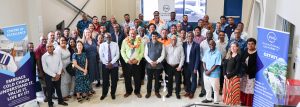
Participants of the short course on Integrated Technical Training in Cold Chain Equipment Management and Health Facility Solar Electrification.
More than 30 participants from nine Pacific countries are taking part in a 10-day short course, aimed at strengthening technical capacity in cold chain equipment management and health facility solar electrification at the Fiji National University’s (FNU) Derrick Campus, Samabula.
The Integrated Technical Training in Cold Chain Equipment Management and Health Facility Solar Electrification commenced today, bringing together participants from Tonga, Cook Islands, Samoa, Solomon Islands, Kiribati, Marshall Islands, Vanuatu, Tuvalu and Fiji.
The training provides an opportunity for participants to enhance their technical knowledge and practical skills in maintaining cold chain equipment and solar electrification systems, which are essential for ensuring reliable healthcare services and the safe storage of vaccines across the Pacific.
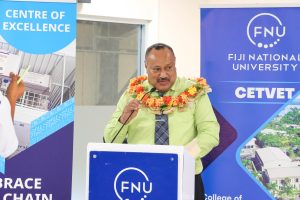
The Acting Deputy Secretary for the Ministry of Health and Medical Services, Dr Tevita Qoriniasi
The Acting Deputy Secretary for the Ministry of Health and Medical Services, Dr Tevita Qoriniasi, said the training addresses critical challenges facing Pacific Island countries, particularly the need for reliable healthcare infrastructure and effective equipment maintenance.
Dr Qoriniasi emphasised the importance of moving away from reactive equipment maintenance towards a preventive maintenance culture to minimise disruptions to essential healthcare services.
“We must champion a preventive maintenance culture. For too long, we have relied on a reactive approach—fixing equipment only after it breaks. This disrupts essential healthcare, inflates costs, and puts precious vaccine stocks at risk.”
“By shifting our focus to regular, preventive maintenance, we can identify problems early, reduce downtime, and ensure that refrigerators, solar direct drive systems, and temperature monitors protect vaccine potency every single day,” Dr Qoriniasi said.
Dr Qoriniasi further highlighted the importance of building climate-resilient healthcare facilities, noting that reliable electricity is essential during natural disasters and extreme weather events.
“When severe weather strikes, reliable electricity is a lifeline for maternal services, emergency care, and vaccine storage. Integrating solar electrification with cold chain management ensures our facilities keep running during power cuts.”
“This is more than an environmental solution. It is a vital shield for the most vulnerable people in our communities,” he explained.
Dr Qoriniasi acknowledged FNU’s partnership in delivering the initiative, describing the collaboration as an important contribution towards the vision of establishing Fiji as a Regional Centre of Excellence.
He said the initiative would help develop a skilled workforce and strengthen technical leadership across the Pacific.
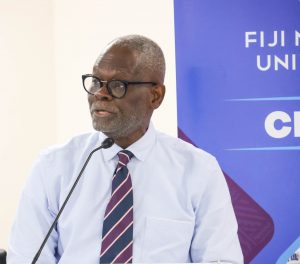
The Fiji National University’s Pro Vice-Chancellor Corporate Services, Professor Nii-K Plange.
The Pro Vice-Chancellor Corporate Services, Professor Nii-K Plange, said FNU remained committed to providing education that responds to real needs, research that addresses practical challenges, and partnerships that deliver meaningful benefits to communities.
“For FNU, this initiative brings together some of our greatest strengths. We are a multidisciplinary university, with engineering, health sciences and technical and vocational education all under one roof. This gives us a unique opportunity to connect knowledge across disciplines and turn it into practical solutions,” Professor Plange said.
Professor Plange also highlighted the proposed Regional Centre of Excellence as an important next step in strengthening the region’s technical capabilities.
“It offers an opportunity for FNU to support the development of specialised skills, strengthen research and teaching, and help build the technical capacity our Pacific countries need. It is also an opportunity to deepen our partnerships with governments, regional organisations and development agencies,” he added.
Professor Plange further stated that the training brings together people, knowledge and practical skills to address key challenges that directly impact the health and well-being of communities across the Pacific.