
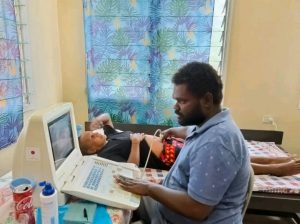
David Totoka Pitanoe at work.
For David Totoka Pitanoe, the journey from Noro Town in Solomon Islands to becoming a Senior Radiographer and health services manager began with a simple recommendation from a high school friend.
Years later, after earning three qualifications from the Fiji National University (FNU), David has returned home with the knowledge and skills he now uses at Gizo Hospital, where he supervises the Medical Imaging Department.
A first-generation university student from his family, David first came to FNU to study the Bachelor of Medical Imaging Science, graduating in 2017. His interest in the management side of healthcare, later brought him back to the university, where he completed a Postgraduate Diploma in Health Services Management in 2023 and a Master of Health Services Management in 2025.
For David, the journey has been about more than collecting qualifications. It has been about learning, meeting people, overcoming challenges and finding ways to use what he has learned back home.
The youngest of five siblings, David was born and raised in Noro Town. His father is a retired seafarer and former fleet manager for a fishing company, while his mother is a stay-at-home mum. Growing up, his parents encouraged him to value education and work towards a meaningful career. His interest in medical imaging, developed from seeing the important role radiology plays in diagnosing illnesses and supporting patient care.
“I have seen the direct impact of radiology on diagnosis and patient outcomes, and that has been a motivating factor for me,” he said.
His path to FNU began when a high school friend encouraged him to explore the university’s programmes. With little family experience of navigating university education, David researched his options and worked through the admission process with his friend’s support.
He eventually chose FNU because of the learning environment and the support available to students.
“I chose FNU for its strong reputation, high-quality teaching, approachable lecturers, flexible course programmes, and solid student support systems. Engaging with students from diverse Pacific cultures opened my mind to new perspectives and unique ideas,” David added.
Studying in Fiji also introduced David to students from different parts of the Pacific. The friendships he formed became an important part of his university experience.
Being away from home was not always easy. There were times when he missed his family and important occasions back home, but he kept reminding himself why he had come to Fiji.
“I stayed motivated by focusing on my ultimate goal, which is supporting my family,” he further stated.
Some of his happiest university memories came from the friendships he made along the way.
“Relaxing over kava with my Pacific brothers and spending time together on weekends are among the moments he remembers most fondly,” David explained.
His lecturers also played an important role in his academic journey, particularly Dr Ledua Tamani, his research supervisor at the School of Public Health. David credits Dr Tamani’s guidance and support as an important part of completing his master’s research.
His postgraduate studies also changed the way he looked at healthcare, giving him a better understanding of the leadership and planning needed to keep services running in communities where resources can be limited.
“Pacific health systems often operate with limited resources, making effective planning and leadership essential to meet population needs,” he highlighted.
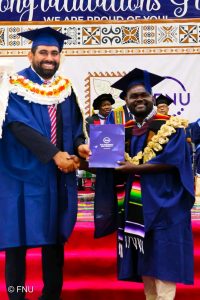
David Totoka Pitanoe during his graduation from FNU
What he learned at FNU continues to influence the way he approaches his work.
“FNU equipped me with practical skills and knowledge tailored to solving real-world challenges. The practical attachments, case studies, and research experiences empowered me to become an effective leader and team member,” said David.
At Gizo Hospital, David now brings together his experience as a radiographer and the management skills gained through his postgraduate studies. His work includes contributing to health service planning, improving service delivery and mentoring members of his team.
“My qualifications have provided me with the expertise needed to manage health resources efficiently and contribute positively to my country’s health outcomes and development,” he expressed.
For David, however, education is not only about building a career. It is also about creating opportunities for families and communities.
“Education is a powerful tool to overcome poverty and social injustice. It brings stability, security, and progress, giving us the credibility to positively influence our families, communities, and nation,” David stated.
His time in Fiji and his return home have also shaped what being an FNU alumnus means to him.
“To me, being an alumnus means being part of a broader Pacific community dedicated to driving meaningful change and giving back to our home countries,” he reiterated.
Completing his Master of Health Services Management in 2025 remains one of David’s proudest achievements. As someone who was the first in his family to navigate university education, reaching that point took commitment, patience and perseverance.
Today, David is putting that knowledge to work at Gizo Hospital, serving patients and helping support healthcare delivery in his home country.
Looking back, he encourages young Pacific Islanders to make the most of the opportunities available to them.
“Apply, stay focused on your goals, learn as much as you can, build meaningful friendships, and enjoy the journey. And if I could speak to the young man who walked through the doors of FNU for the first time, I would advice him to trust the process, stay resilient through the challenges, and remember why he started,” he emphasised.
David’s journey is far from over. He hopes to become a published author while continuing to build his knowledge through further study, carrying with him the lessons, friendships and experiences that began with a recommendation from a high school friend and took him from Noro Town to FNU and back home again.