
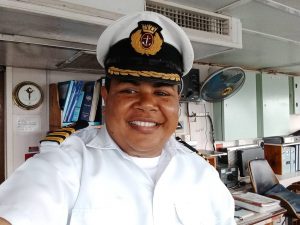
Captain Susana Balekana
Life at sea taught Captain Susana Balekana lessons no textbook could fully capture.
It taught her that leadership is earned through responsibility, that difficult situations can reveal strengths, and that some of the most valuable lessons come from experience rather than a manual.
When Captain Balekana entered maritime training in 1997 as a Stage 1 Deck Apprenticeship student at the then Fiji Maritime Studies, now the Pacific Centre for Maritime Studies (PCMS), her goal was to complete her training and earn her qualification.
Nearly three decades later, that decision has taken her across the Pacific and into roles she could not have imagined as a young apprentice, including commanding a salvage tugboat in Papua New Guinea.
Today, she has returned to the institution where her maritime journey began, this time as an instructor. The bridge has been replaced by the classroom, but the lessons she learned at sea continue to shape how she teaches. Leaving active sea service was not an easy decision for Captain Balekana. She had always enjoyed life at sea, but over the years she discovered another part of the profession that gave her a different kind of fulfilment, helping others grow.
“Deep down, I had always known that I would eventually return to PCMS,” she said.
Coming back to teaching has therefore felt less like leaving one career behind and more like continuing something that had already been part of her life at sea: helping others find their way.
One of her earliest lessons was that a position or title does not automatically earn respect. Her years in Papua New Guinea placed her in situations where she had to prove herself in a predominantly male environment. As one of the few women onboard, she learned that her work, conduct and ability to handle responsibility would speak louder than her title.
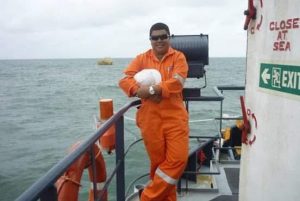
Life at sea taught Captain Susana Balekana lessons no textbook could fully capture.
She was fortunate to work under employer Jurgen Ruh, who recognised her potential and gave her opportunities to develop through practical experience. His confidence in her abilities eventually led to an opportunity to command a salvage tugboat.
For Captain Balekana, being trusted with that responsibility was a turning point. It showed her what can happen when someone is given the opportunity to prove what they are capable of.
It also shaped the way she now approaches her own students. She wants them to be prepared not only to pass examinations, but to recognise and step up when responsibility comes their way.
For Captain Balekana, preparing a good maritime professional begins long before a student steps onto a vessel.
Technical knowledge is important, but so are the qualities that allow someone to work safely and effectively in a demanding environment. She looks for punctuality, discipline, adaptability, accountability and, above all, a genuine willingness to learn.
“Excellence is the ability to combine competence with character,” she added.
Those qualities become especially important when people are working under pressure, making decisions and relying on one another. For Captain Balekana, that is where training becomes more than simply learning what is in a textbook.
Her own career has also given Captain Balekana a personal connection to the growing participation of women in maritime.
When she began her career, seeing women onboard vessels was far less common. She understands the uncertainty that can come with entering an industry where you may not always see people like yourself represented.
As an iTaukei woman, she draws strength from the values she was raised with, including humility, perseverance, respect and community. She wants young iTaukei women to see those qualities as strengths they can bring into maritime, rather than something that holds them back. Her message is particularly important for young women who may not yet picture themselves becoming officers, captains or maritime leaders.
“I want young iTaukei women to be confident in their abilities, take pride in who they are, and understand that there is a place for them on any ship roster,” Captain Balekana expressed.
Years of working with people from different countries and cultures have also taught Captain Balekana the importance of communication and teamwork. Modern vessels often bring together people from different backgrounds, languages and experiences. Being able to work respectfully and effectively with others is therefore just as important as technical competence.
She believes women bring valuable qualities to maritime teams, including strong communication, attention to detail and leadership potential. For her, however, the bigger goal is to create workplaces where every qualified person has the opportunity to contribute and grow. That starts with training environments where students learn to work with people whose experiences may be different from their own.
Captain Balekana has now experienced responsibility from both sides of maritime education. At sea, she had to respond to changing conditions, make decisions and keep the safety of the vessel and crew in mind. In the classroom, the consequences are less immediate, but the impact can reach much further.
The students she teaches today may eventually become responsible for vessels, cargo, marine environments and the safety of people onboard. That is a responsibility she does not take lightly. She draws on situations from her own career to help students understand how what they learn in the classroom applies once they step aboard a vessel.
In addition, her aim is to ensure that when her students enter the industry, they are ready to connect what they have learned with the realities of life at sea.
For Captain Balekana, increasing the number of women entering maritime is only part of the challenge. The industry must also create conditions that encourage women to stay, develop their skills and progress into leadership. That means safe workplaces, professional development, mentoring and genuine opportunities to advance.
Having experienced a male-dominated environment herself, she knows there is a difference between simply giving someone an opportunity and supporting them to build a career.
For women to remain in maritime and succeed, she believes they need to know that their contribution is valued throughout their careers. Perhaps the most meaningful part of becoming an instructor is knowing that her experience can continue through the people she teaches.
Captain Balekana has already watched former students move into maritime careers across the Pacific and beyond. Their achievements remind her that what begins in one classroom can travel far beyond it.
For a woman who first walked through the doors of Fiji Maritime Studies as a young apprentice in 1997, returning nearly three decades later as an instructor brings her journey full circle.
But Captain Balekana is not simply looking back. She is using what she learned at sea to prepare the next generation, one student, one lesson and one opportunity at a time.