
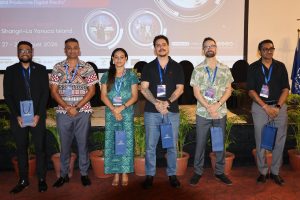
For Ofa Lagonilakeba, attending the National Conference on Information Technology (NCIT) 2026, was about more than discussing technology. It was an opportunity to ensure the voices and experiences of women in Information, Communication and Technology, telecommunications and cybersecurity were part of the conversation shaping the Pacific’s digital future.
An ICT & Cybersecurity Graduate Trainee with the Civil Aviation Authority of Fiji (CAAF), Ms Lagonilakeba joined industry leaders, policymakers and technology professionals, to explore the future of the Pacific’s digital economy, while advocating for greater representation, mentorship and opportunities for women and young people.
As a panellist in Panel Discussion 3: Trust in the Digital Economy: AI, Cybersecurity and the Future of Commerce in the Pacific, she shared her experiences working in a field often perceived as male dominated.
“My main reason for being here is to share the experiences, women are facing in the current ICT and telecommunications industry.”
“People often say it is a male-dominated industry, but it is an industry for everyone. Women are here, and it is important that people see us contributing and leading in these spaces,” she said.
Ms Lagonilakeba believes greater visibility and stronger mentorship are essential to encouraging more young people, particularly women and those from maritime communities, to pursue careers in ICT, telecommunications and cybersecurity.
“We need the right mentors to guide our youth and show them the many opportunities this industry has to offer,” Ms Lagonilakeba added.
She stressed that young women, girls and boys all have an important role to play in shaping Fiji’s digital future, including contributing to ICT policies and legislation.
“We need to be present in those spaces, not only when consultations take place but throughout the decision-making process,” She also stated.
During the discussion, Ms Lagonilakeba also addressed the growing need to prepare the next generation of Pacific professionals for increasingly sophisticated cyber threats.
She acknowledged that while young people are digitally confident and eager to learn, access to practical training, specialist mentors and industry experience remains uneven across the region.
“To close that gap, we need more hands-on learning through cyber labs, simulations, internships, industry certifications and regional exchange programmes.”
“Preparedness is not only about technical knowledge. It also requires communication, ethics, critical thinking and an understanding of our Pacific context,” Ms Lagonilakeba highlighted.
She called for stronger partnerships between schools, universities, governments and industry to equip young people with the skills needed to respond to emerging digital challenges.

For Ms Lagonilakeba, knowledge-sharing is equally important in building a resilient ICT workforce.
“At the end of the day, you cannot keep knowledge to yourself. There is always someone who will come after you, and we have a responsibility to help prepare them,” she said.
Ms Lagonilakeba also highlighted the importance of initiatives that connect young women with mentors, professional networks, scholarships and practical industry experience, while encouraging employers to create inclusive workplaces where women can progress into technical and leadership roles.
The panel discussion also examined the growing cybersecurity risks facing organisations across the Pacific, including ransomware, data breaches and AI-enabled scams.
Ms Lagonilakeba noted that many organisations, particularly small and medium-sized enterprises, continue to face challenges due to limited resources, skills shortages and ageing systems.
She encouraged businesses to strengthen their cyber resilience by implementing practical measures such as multi-factor authentication, secure and regularly tested backups, timely software updates, staff awareness training and rehearsed incident response plans.
“The goal is not to prevent every cyberattack because that is unrealistic.”
“The goal is to make organisations harder to compromise, faster to recover and more transparent with customers when something goes wrong,” she reiterated.
As NCIT 2026 brought together leaders from across government, industry and academia under the theme “From Vanua to Virtual: People, Trust and Technology Driving a Secure, Trusted and Productive Digital Pacific,” Ms Lagonilakeba said the conference reinforced the importance of inclusion alongside innovation.
For her, building the Pacific’s digital future means ensuring women and young people are not only represented in conversations about technology but are also actively shaping the decisions that will define the region’s digital transformation.
“We are here, and we have a role to play,” said Ms Lagonilakeba.