
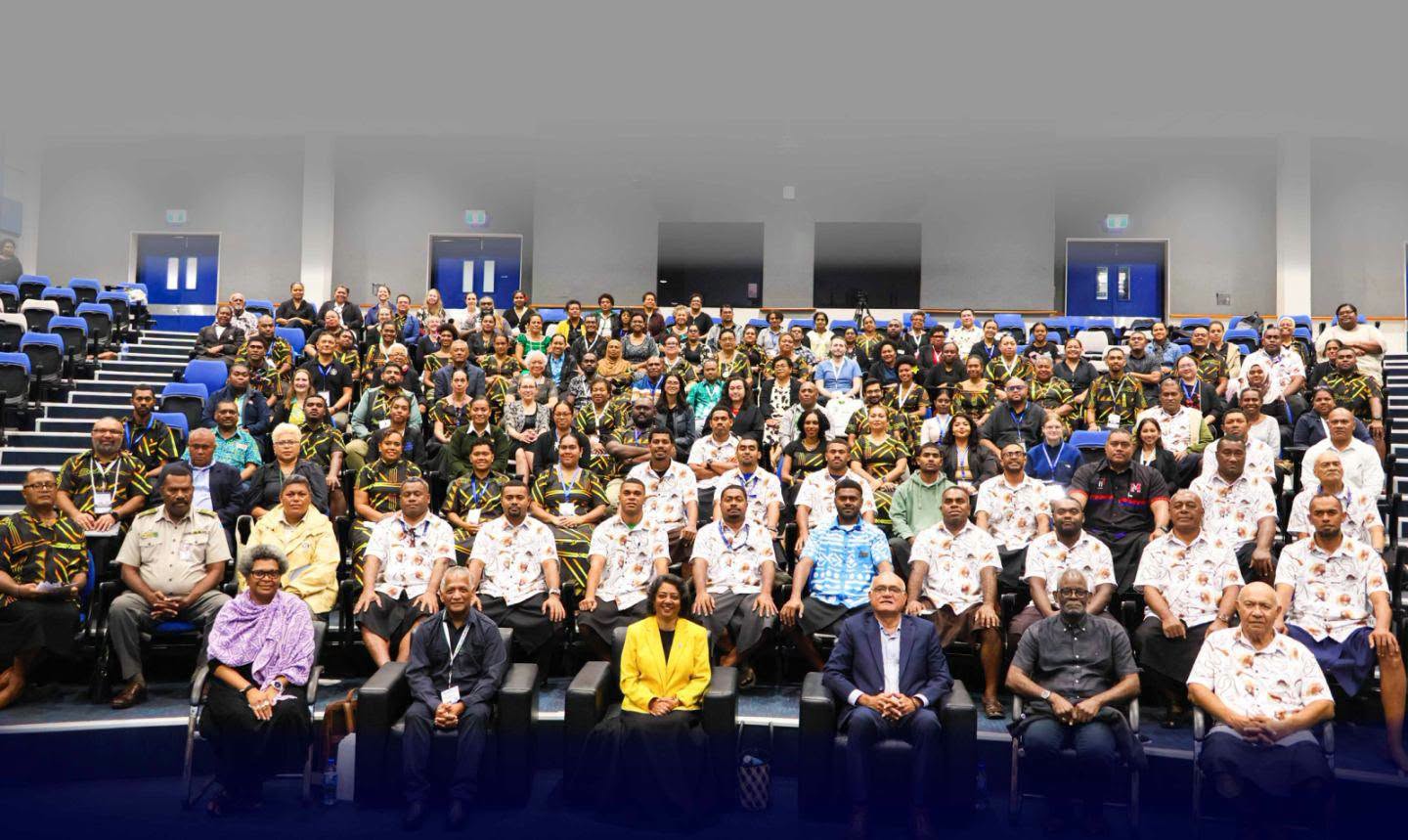
Participants at the Reframing the National GBV Response dialogue
Despite four decades of legislation, policies and more than $140 million invested in addressing gender-based violence (GBV), Fiji continues to record one of the highest prevalence rates in the world. This has prompted researchers, policymakers, traditional leaders, and service providers to ask a difficult but necessary question – Is the national response working?
That question took centre stage at “Reframing the National GBV Response: Engaging iTaukei Men, Institutions and Systems,” a high-level dialogue convened by the Fiji National University (FNU) as a side event of the Pacific Islands Health Research Symposium (PIHRS) 2026, held at FNU’s Nasinu Campus.
The dialogue brought together representatives from government, academia, the Great Council of Chiefs (GCC), faith-based organisations, civil society, the health sector, and research institutions to examine gaps in Fiji’s current response and explore practical, evidence-informed approaches.
Two panel discussions formed the core of the dialogue, focusing on Alternative Frameworks for Addressing Gender-Based Violence and Strengthening GBV Data for an Evidence-Based Response.

FNU Vice-Chancellor Professor Unaisi Nabobo-Baba at the GBV Response event
While opening the dialogue, FNU Vice-Chancellor Professor Unaisi Nabobo-Baba challenged participants to look closely at why decades of investment and policy action have not resulted in a significant reduction in GBV prevalence.
“Fiji has worked at this for forty years. We have the laws, the policies and the first National Action Plan in the Pacific. Since 2016, more than one hundred and forty million dollars has gone into the response. The prevalence has not moved,” Professor Nabobo-Baba said.
The Vice-Chancellor added that emerging FNU research points to the limited involvement of iTaukei men in research, consultation and programme design as an area requiring greater attention.
“The men who are the primary perpetrators of this violence have been almost entirely absent from the research, the consultation and the design of the interventions meant to stop them,” the Vice-Chancellor added.
Professor Nabobo-Baba also called for greater cultural grounding in how GBV is understood and addressed, alongside more precise language and a stronger public health approach supported by quality data. She urged participants to ensure the dialogue leads to action.
“Do not let today end in agreement. Let it end in a document, a Call-to-Action naming what must change that can be carried to the Ministry, to the Vanua and to the Great Council of Chiefs. If you produce it, this University will carry it,” Professor Nabobo-Baba stated.
The Chief Guest and Minister for Women, Children and Social Protection, Honourable Sashi Kiran, described GBV as one of Fiji’s most

Honourable Sashi Kiran, Minister for Women
urgent public health, human rights, and development challenges.
Honourable Kiran presented national statistics highlighting the scale of the issue, noting that Fiji’s prevalence rate for violence against women stands at 64 per cent, almost twice the global average.
In addition, children continue to carry a particularly heavy burden of sexual violence, accounting for 93 per cent of High Court rape victims in 2024 and 100 per cent in 2025. Between 2020 and 2025, 4,793 cases of sexual abuse against children were reported, compared with 2,153 cases involving women.
The Minister also highlighted findings from the 2025 SCORE Survey, which found that 76 per cent of young men aged 18 to 35 believe a husband may “discipline” his wife, while 57 per cent of young women shared the same view.
Honourable Kiran stressed the importance of engaging adolescent boys early to challenge harmful attitudes and promote respectful relationships, noting that acceptance of violence is not disappearing among the younger generation.
For FNU, the dialogue is about bringing research and education closer to the realities facing Fiji’s communities. It provides an opportunity to listen, learn and work with partners to better understand what needs to change.
As Fiji’s national university, FNU has a responsibility to ensure that knowledge generated through research can be useful beyond the university. This means creating opportunities for researchers, students, policymakers, and communities to share ideas and find practical ways forward.
The dialogue also adds to the conversations taking place at PIHRS 2026, bringing together research, policy, traditional knowledge, and community perspectives around one of Fiji’s most pressing challenges.