
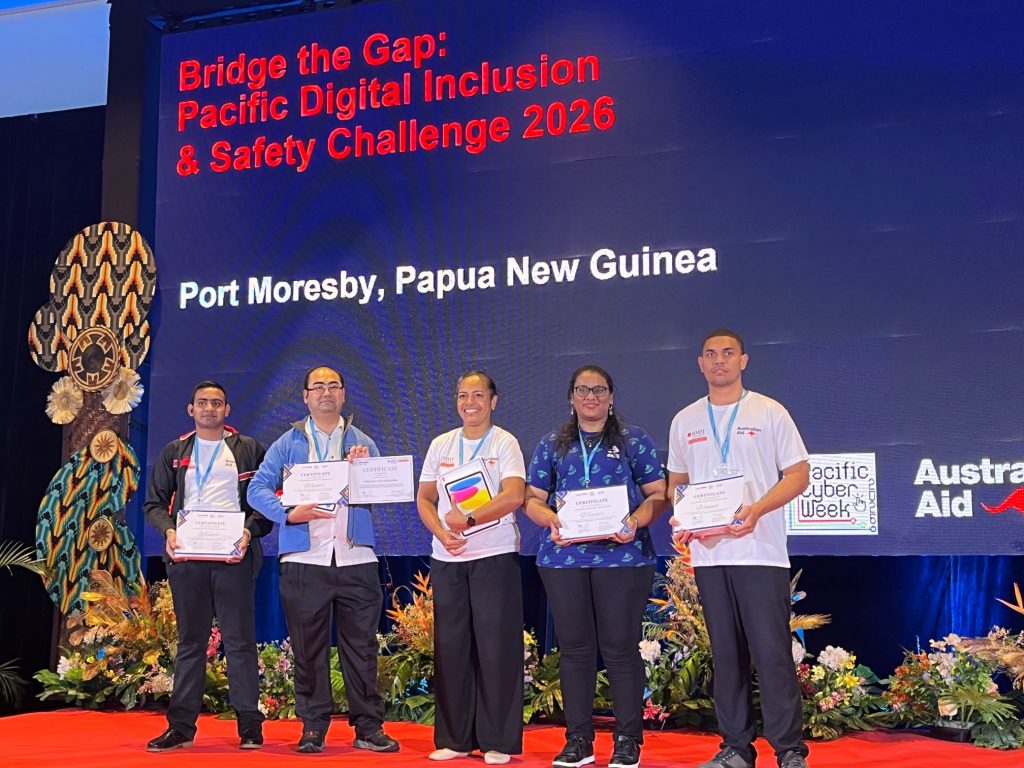
The Fiji National University lecturer, Mr Hermann Jamnadas (second from left), with his team following their win at the 48-hour hackathon challenge in Port Moresby, Papua New Guinea last month.
The Fiji National University (FNU) has claimed first place in the Bridge the Gap: Pacific Digital Inclusion & Safety Challenge 2026, emerging as the winner of an intensive 48-hour hackathon focused on innovation, teamwork and digital problem-solving.
The competition was held during Pacific Cyber Week 2026 at the APEC (Asia-Pacific Economic Cooperation) Haus in Port Moresby, Papua New Guinea, last month.
The FNU team was led by Mr Hermann Jamnadas, a lecturer from the University’s College of Engineering, Technical Vocational Education and Training (CETVET), School of Mathematical and Computing Science.
The team also comprised CETVET’s School of Mathematical and Computing Science students, Mohammed Shohaib Khan and Tevita Turgaitoga Vibose, as well as Shaanam Prasad and Bulou Elenoa Navolaca Naivalu from FNU’s National Training and Productivity Centre (NTPC).
Mr Jamnadas said the team’s goal was to give staff and students an opportunity to apply their knowledge to a real regional challenge while representing FNU on an international stage.
The challenge focused on cyber safety and digital inclusion across the Pacific.
Before the competition, the team submitted a Lean Canvas outlining its initial concept, along with a short introductory video known as a “Gaddie Pitch”. Their solution, KoroSafe, impressed the judges.
KoroSafe is an anonymous, AI-powered platform designed to support victims of cyberbullying by providing a safe space for emotional recovery, guidance and access to trusted support.
Mr Jamnadas said the project aligned with three of the five priorities in FNU’s Strategic Plan 2024–2026: Priority Area 1 – Inclusiveness and Diversity (People, Place and Cultures); Priority Area 3 – Research, Innovation, Social and Technological Development; and Priority Area 5 – Education for Employment and Internationalisation.
“KoroSafe was developed in direct response to the growing incidence of cyberbullying, online harassment, scams and digital abuse affecting young people, women and other vulnerable users in Fiji,” said Mr Jamnadas.
The Fiji National University team receiving their prize following their win at the 48-hour hackathon challenge in Port Moresby, Papua New Guinea last month.
He added that their earlier research, which included empathy mapping, persona development and community barrier analysis, revealed that many victims feel isolated, fear judgement from their communities and often do not know where to seek help.
Following feedback from mentors during the hackathon, the team refined the concept to focus on an anonymous, AI-supported platform where victims could connect with mentors who had overcome similar experiences.
“The long-term goal is to help users rebuild their confidence and, in time, become mentors themselves. The experience would also contribute to teaching and learning within FNU’s Computer Science and Information Systems (CSIS) programmes. We plan to introduce more structured design-thinking and Gender Equality, Disability and Social Inclusion (GEDSI) activities, including empathy mapping and community insight gathering, into future coursework and student projects,” he added.
Mr Jamnadas also stated that FNU is also better positioned to prepare students for future regional competitions by drawing on the mentoring and leadership experience gained through this challenge.
The team’s two female representatives, Bulou Elenoa Navolaca Naivalu and Shaanam Prasad, also highlighted the importance of encouraging more women to pursue careers in science, technology, engineering and mathematics (STEM).
Ms Naivalu, an Assistant Instructor and postgraduate Information Technology student, said visibility and mentorship were important in inspiring the next generation.
“It’s always encouraging to see Pacific women teaching, presenting and contributing to these spaces because it builds confidence in young women and girls by showing them that these careers are achievable. I will continue to learn and mentor other young women and girls who aspire to build careers in STEM and, prayerfully, help make a positive difference in our communities,” she said.
Ms Prasad said contributing to KoroSafe allowed her to apply her knowledge of information technology and cybersecurity to address a real-world issue.
“As a woman in cybersecurity, I hope to inspire more young women to pursue careers in STEM, information technology and cybersecurity, and to become future leaders in technology,” said Ms Prasad.
The win highlights the growing role of FNU students and staff in developing practical and innovative solutions to challenges facing communities in Fiji and across the Pacific.