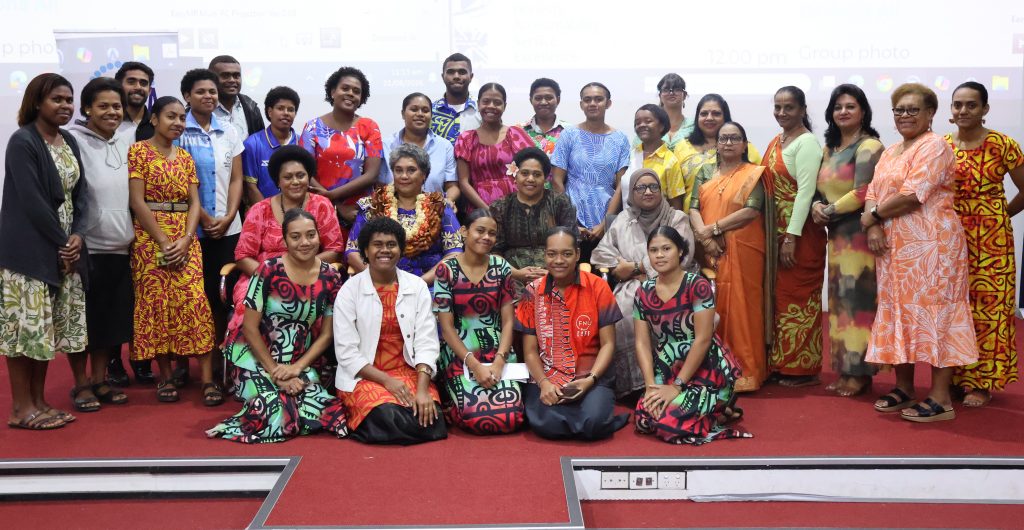
FNU staff and students following the Vernacular Week celebration at Natabua Campus.
Speaking and writing in the vernacular languages of Fiji will ensure their survival and keep them from extinction,” says College of Humanities, Education and Law (CHEL) Head of the Department of Language and Literature, Ms Sera Lockington.
Ms Lockington shared this message at the closing ceremony of FNU’s inaugural Vernacular Week at Natabua Campus last week.
Held under the theme “Empowering Indigenous Voices,” the week brought students and staff together through poetry, debates, music, cultural performances, visual arts and other activities celebrating Fiji’s linguistic and cultural diversity.
Ms Lockington, who officiated at the closing ceremony, said vernacular languages were closely connected to people’s identity, culture and heritage.
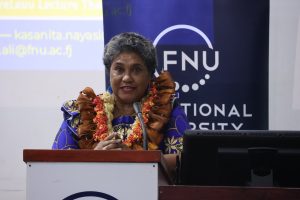
College of Humanities, Education and Law (CHEL) Head of the Department of Language and Literature, Ms Sera Lockington.
“Words in our vernacular hold profound meanings and traditional truths that cannot be adequately expressed in languages that are not our own.”
She also highlighted the importance of preserving Fiji Hindi or Fiji Baat, particularly as it continues to be spoken by younger generations.
Ms Lockington added that tertiary institutions had an important role to play in keeping languages, cultures and traditions alive.
“The Diploma in Vanua Leadership programme, pioneered by FNU Vice-Chancellor, Professor Unaisi Nabobo-Baba, in collaboration with Fiji’s Great Council of Chiefs, is a classic example. The sausauvou, or young chiefs of the country, are being mentored to take up leadership roles in their provinces, villages and districts. This is an excellent initiative because these young, educated leaders can be the agents of change in in their villages and communities and help shape the direction of the future and the nation with regards to blending traditional indigenous customs with modern governance skills.”
The Assistant Professor and Committee Chair, Dr Kasanita Nayasi, said Vernacular Week was created to give students a space to celebrate and use their languages with confidence.
“At CHEL, we have a particular responsibility to encourage our students to value language and culture. Our students are not only learners; many of them will become teachers, professionals, leaders and community members who will influence future generations,” Dr Nayasi said.
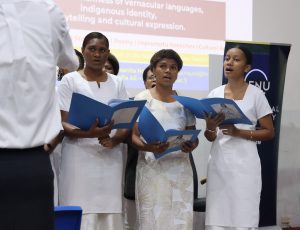
FNU students performing at the Vernacular Week celebration closing ceremony.
She further stated that throughout Vernacular Week, FNU students and staff have demonstrated this through their participation in poetry recitals, debates, original song compositions, visual arts, cultural performances and other activities.
“These activities have allowed our students to express themselves creatively and confidently in different languages,” reiterated Dr Nayasi.
The week celebrated iTaukei, Hindi and Urdu, while encouraging students to appreciate the importance of language in preserving identity, culture and heritage.
For CHEL, the celebration was also an opportunity to remind students that their languages have a place in education and everyday life, and that keeping them alive is something everyone can contribute to.
The inaugural Vernacular Week reflects FNU’s commitment to celebrating Fiji’s diversity and encouraging the next generation to value, use and pass on the languages that connect them to their communities and heritage.