
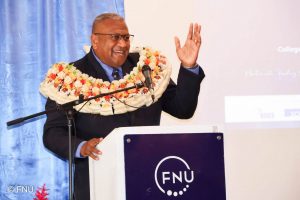
Chief Guest and Assistant Minister for Health and Medical Services, Honourable Penioni Ravunawa opened the two-day Health Professionals Education Symposium at the Pearl Resort in Pacific Harbour.
“Healthcare education is not simply about delivering knowledge. It is about producing competent professionals who can meet the realities of modern healthcare.”
This was the powerful message delivered by the Chief Guest and Assistant Minister for Health and Medical Services, Honourable Penioni Ravunawa, during the opening ceremony of the Fiji National University’s (FNU) College of Medicine, Nursing and Health Sciences (CMNHS) two-day Health Professionals Education Symposium, currently underway at The Pearl Resort in Pacific Harbour.
Held under the theme, “Practice into Teaching, Simulation into Learning: Understanding How We Teach to Shape How Students Learn,” the symposium brought together healthcare professionals, educators, researchers and regional partners to explore innovative approaches to health professions education.
In his address, Honourable Ravunawa emphasised that every investment made in education must translate into better patient outcomes, stronger health systems and a workforce capable of responding to the evolving needs of communities.
“Health professions education is one of the most important investments a nation can make. The return on that investment is measured not only in graduation numbers, but in safer patient care, reduced medical errors, stronger clinical leadership, improved workforce retention and healthier communities. Every dollar invested in quality teaching today yields long-term dividends for our healthcare system tomorrow,” Honourable Ravunawa said.
“The healthcare workforce of the future must be clinically competent, technologically capable, culturally responsive, emotionally intelligent and resilient under pressure. They must be able to work collaboratively across professions, communicate effectively, embrace innovation and provide care with empathy and dignity.”

Participants engage in discussion session during the Health Professionals Education Symposium at the Pearl Resort in Pacific Harbour.
He also acknowledged the valuable contributions of international partners, particularly KOICA and Soonchunhyang University, whose continued support has strengthened faculty development, simulation-based learning, academic partnerships and health workforce capacity-building initiatives.
“As we look ahead, our challenge is not simply to educate more health professionals. Our challenge is to educate the right workforce with the right skills, in the right numbers, for the right places. That requires alignment between education providers, healthcare employers, professional bodies, policymakers and development partners. It requires data-driven workforce planning, continuous curriculum improvement, investment in teaching excellence and a commitment to lifelong learning,” he said.

Head of School of Health Sciences, Assistant Professor Raymond Keshwan shared his remarks at the Health Professionals Education Symposium at the Pearl Resort in Pacific Harbour.
CMNHS Head of the School of Health Sciences, Assistant Professor Raymond Keshwan, highlighted the critical role simulation-based learning plays in modern healthcare education.
“Simulation allows students to practise before they perform, to make mistakes before real patients are affected, to reflect before harm occurs, and to build confidence before they enter complex clinical environments. It gives us a way to teach not only knowledge, but judgement, teamwork, communication, professionalism and safe practice,” Assistant Professor Keshwan explained.
He added that simulation-based learning helps transform everyday clinical experiences into structured and meaningful learning opportunities.
“A busy ward, a laboratory, an imaging room, a dental clinic, a public health field visit or a nursing station can all become powerful learning spaces if we design the experience properly, guide the learner carefully and provide meaningful feedback,” he said.
“As educators and healthcare leaders, our responsibility is not only to produce graduates who can pass examinations. Our responsibility is to help form health professionals who can think clearly, act ethically, communicate respectfully, serve compassionately and continue learning throughout life.”
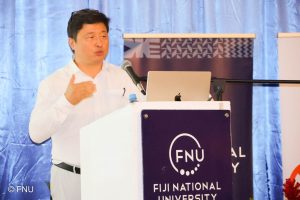
Soonchunhyang University College of Medicine, Professor Jang Yong Kim delivered his presentation.
The symposium also featured panel discussions involving representatives from Soonchunhyang University College of Medicine, CMNHS faculty members and regional partners. Discussions focused on simulation-based education, innovative teaching methodologies, and strengthening healthcare education across the Pacific region.
ENDS