
“Innovation in Pacific journalism is not about copying global trends. It is about indigenising technology and digitising our ancestral strengths.”
This powerful message was delivered by keynote speaker and Founder and Director of Sauvaka Culture Consultancy, Mr Simione Sevudredre, during the World Press Freedom Day celebration organised by the Fiji National University’s (FNU) College of Humanities, Education and Law (CHEL) School of Communication, Language and Literature at the Nasinu Campus yesterday.
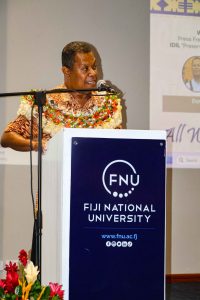
Keynote speaker and Sauvaka Consultancy Founder and Director, Simione Sevudredre delivers his remarks.
Held in conjunction with the International Decade of Indigenous Languages (IDIL) 2022–2032, the celebration brought together media professionals, academics, students and industry leaders to discuss the future of journalism in the Pacific.
Mr Sevudredre stressed that innovation in journalism should empower Pacific communities while protecting cultural identity and indigenous knowledge systems.
“Technology should amplify our stories, not erase our identities,” he said.
“For journalism to survive, it must be financially, culturally and ethically sustainable.”
He highlighted that Pacific indigenous languages contain valuable knowledge and traditions that are deeply connected to the region’s identity.
“Across the Pacific, our languages carry genealogies, ecological knowledge, conflict-resolution systems and spiritual frameworks that Western journalism cannot replicate.”
He also noted that journalism remains a critical tool in addressing the region’s growing challenges.
“The Pacific faces overlapping crises — climate displacement, resource extraction, cyber threats, gender-based violence and political instability. Journalism is one of our strongest tools to navigate these challenges.”
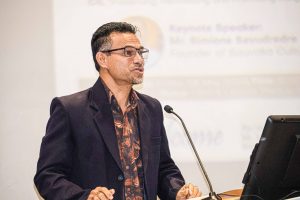
CHEL Associate Dean TVET, Mr Jerry Wong welcomes guests, staff and students at the World Press Freedom Day Celebration.
FNU CHEL Associate Dean Technical, Vocational, Education and Training (TVET), Mr Jerry Wong in his welcome address emphasised the importance of a free and responsible media in fostering peaceful and inclusive societies.
“Press freedom is not simply about reporting the news; it is about ensuring that people have access to accurate information, diverse perspectives and truthful storytelling,” Mr Wong said.
“It allows communities to engage in meaningful dialogue, hold institutions accountable and contribute towards national development and security.”
FNU Head of School of Communication, Language and Literature, Ms Suzie Aziz, encouraged students to uphold ethical journalism standards in an increasingly complex media environment.
“World Press Freedom Day reminds us that a free, responsible and ethical press is not just a pillar of democracy — it is central to building trust, accountability and peace in our societies,” Ms Aziz said.
“As we navigate an increasingly complex media environment shaped by digital transformation, misinformation and rapidly changing audience expectations, it becomes even more important to remain grounded in the values of truth, integrity and inclusivity.”
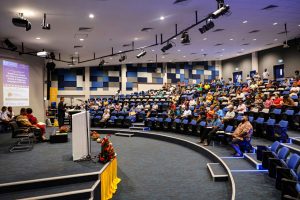
Staff and students actively participate in the World Press Freedom Day Celebration.
A key highlight of this year’s celebration was the introduction of a panel discussion for the first time, focusing on the topic: “The Future of Journalism in the Pacific: Innovation, Sustainability and the Power of Indigenous Languages for Peace, Human Rights, Development and Security.”
The panel featured third-year FNU Bachelor of Media and Communications student Ayla Bakai, Legend FM radio personality Peni Vuniwawa, FNU Lecturer in Communications Josaia Tulomana, Islands Business Magazine owner Netani Rika and Mai TV Co-owner Stanley Simpson. The discussion was moderated by Theresa Fox.
Panellists shared insights on the evolving media landscape in Fiji and the Pacific, highlighting the importance of embracing innovation while preserving indigenous languages and cultural identities.
ENDS