
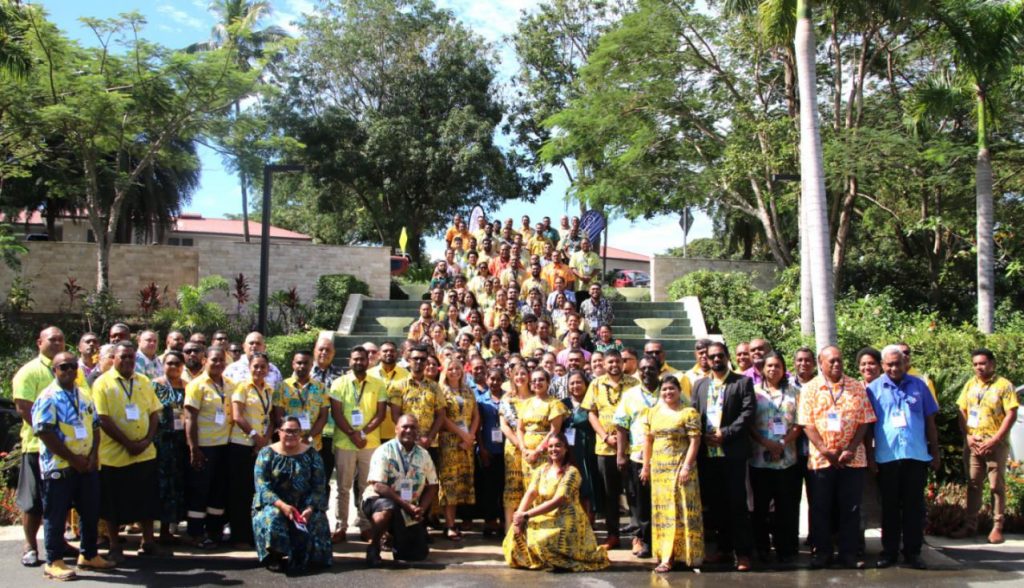
Participants at the Fiji OHS Conference 2026
Fiji is being urged to take immediate and coordinated action to address psychosocial risks in the workplace, as experts warn that neglecting mental health and wellbeing is already having far-reaching consequences for individuals, families, and national productivity.
This call was made at the 2026 Fiji Occupational Health and Safety (OHS) Conference, hosted by the Fiji National University (FNU) through its National Training and Productivity Centre at the Crowne Plaza today.
Bringing together government, industry leaders, academics, and regional partners, the conference focused on the theme: “Good psychosocial working environments: A pathway to thriving workers and strong organisations.”
Opening the conference, Isimeli Tagicakiverata, FNU’s Pro-Vice-Chancellor TVET, warned that Fiji can no longer afford to treat mental health and workplace wellbeing as optional considerations.
“When mental health is neglected, it does not remain contained. It ripples outward, affecting families, communities, and entire societies,” he said.
Dr Tagicakiverata highlighted the growing link between workplace stress and wider societal challenges, including substance abuse, strained relationships, and gender-based violence.

(L-R): Puamau Sowane, CEO National Fire Authority, Dr Isimeli Tagicakiverata, FNU’s Pro-Vice-Chancellor TVET, Amber Boyd, Lead Facilitator, Synergy Health Ltd, Celia Antonovsky, Chair- Australian Institute of Health & Safety, Sonia Shivagani, Manager National Productivity & Industry Innovation (FNU’s NTPC), Bob Mitchell, Director Productivity & Innovation (FNU’s NTPC)
“These are not isolated issues, they are interconnected. When a worker is struggling mentally, it does not end when they leave the workplace. It follows them home and impacts future generations,” he added.
The conference also underscored that improving workplace wellbeing is not only a labour issue, but a national development priority aligned with Fiji’s economic and social goals.
Dr Tagicakiverata stressed that productivity is fundamentally people driven.
“People thrive when they feel safe, respected, supported, and valued. Psychosocial wellbeing is not just a compliance requirement, it is a productivity imperative,” he said.
Delivering the keynote address, Celia Antonovsky, Chair of the Board of Directors of the Australian Institute of Health and Safety, emphasised that workplace safety is no longer limited to physical hazards.
“Across the world, there has been a significant shift. Psychosocial risks, including stress, bullying, fatigue, and job insecurity, are now recognised as critical workplace hazards,” she said.
She added that mental health must be treated as central to productivity, not secondary to it.
“Psychosocial wellbeing is no longer a peripheral concern; it is fundamental to building resilient workforces capable of navigating change and uncertainty.”
Antonovsky noted that leadership plays a critical role in driving change.
“Creating psychologically safe workplaces is a leadership imperative. Accountability must sit at the highest levels of organisations,” she said.
Speakers stressed that while awareness of psychosocial risks is increasing globally, Fiji must now move decisively from discussion to implementation.
The discussions also linked psychosocial health to broader development frameworks, including workforce resilience, economic growth, and community wellbeing.
Participants were encouraged to move beyond awareness and commit to tangible action in strengthening workplace systems, leadership practices, and organisational cultures.