
The Fiji National University’s (FNU) College of Medicine, Nursing and Health Sciences (CMNHS) has proudly launched the Pacific’s first-ever Pathogen Genomics and Antimicrobial Resistance (AMR) Laboratory at its Pasifika Campus in Suva on Saturday, 28 March 2026.
This landmark initiative, delivered in collaboration with the University of Otago, marks a significant step forward in strengthening the region’s capacity to respond to antimicrobial resistance and emerging infectious diseases. The establishment of the Centre positions Fiji as a regional leader in advanced health research, surveillance, and innovation.

FNU’s Pro-Vice-Chancellor Corporate Services, Professor Nii-K Plange.
FNU’s Pro-Vice-Chancellor Corporate Services, Professor Nii-K Plange highlighted the establishment of this Centre which one of the first of its kind in the Pacific—signals FNU’s firm commitment to advancing research, innovation, and regional leadership in health.
“It reinforces FNU’s role as a hub for transformative education, research excellence, and scientific advancement in service of Fiji and the Pacific. Importantly, this initiative is strongly aligned with Fiji’s national development priorities under the Fiji National Development Plan, particularly in strengthening healthcare systems, improving service delivery, and building resilience against emerging health threats,” Professor Plange stated.
He also explained that AMR, is an escalating public health challenge across Pacific Island countries, directly impacting patient outcomes, healthcare delivery, and the long-term sustainability of our health systems.
“The establishment of this Centre is a direct response to these priorities and aligns with both regional commitments and national goals to modernise and strengthen Fiji’s healthcare infrastructure. This Centre will enhance our ability to understand disease transmission, strengthen surveillance systems, and support timely outbreak responses. The Centre will significantly enhance postgraduate education, specialised training, and research capacity,” he said.

College of Medicine, Nursing and Health Sciences Acting Dean, Dr Amelia Turagabeci delivers her address.
College of Medicine, Nursing and Health Sciences Acting Dean, Dr Amelia Turagabeci while acknowledging the University of Otago for their unwavering support and partnership in making this vision a reality said, “Antimicrobial resistance and infectious diseases continue to pose serious threats to our communities. Through this Centre, we are better positioned to equip our students, researchers, and healthcare professionals with advanced knowledge and skills, while also contributing to evidence-based solutions that will benefit the region.”
“University of Otago’s commitment to excellence, collaboration, and capacity building has been instrumental in bringing this project to life. We are deeply appreciative not only of the technical expertise and resources shared, but also of the spirit of partnership that underpins this initiative.”

(From left) FNU’s Pro-Vice-Chancellor Corporate Services, Professor Nii-K Plange presents a token of appreciation to the University of Otago Vice-Chancellor, Honourable Grant Robertson.
The University of Otago Vice-Chancellor, Honourable Grant Robertson underscored the importance of regional collaboration and building in-country scientific capability to address future health challenges.
“All of us bring different strengths to ensure this laboratory operates effectively. This work is more important than ever. We know the risk of future pandemics remains, and that climate change and other pressures are increasing those risks. The ability to test samples here, understand them in real time, and respond quickly to antimicrobial resistance is critical. What matters is that this work is done here, on the ground—not in distant laboratories—so solutions can be applied where they are needed most. We are proud to have supported this initiative and look forward to strengthening partnerships with FNU through staff and student exchanges, and continued collaboration to improve the wellbeing of our region.”
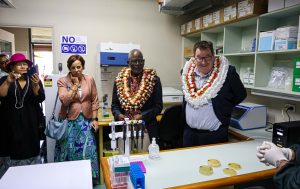
FNU and the University of Otago Delegates tour the Laboratory.
The new Centre is expected to play a pivotal role in advancing genomic research, enhancing disease surveillance, and supporting evidence-based decision-making across the Pacific. It will also serve as a hub for postgraduate training and specialised research, ensuring that local expertise continues to grow in line with global scientific developments.
ENDS