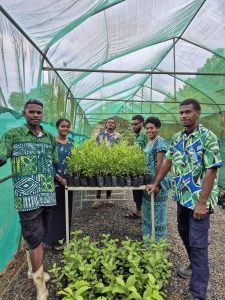
The Fiji National University’s College of Agriculture, Forestry and Fisheries students at the farm nursery during the International Day of Forests at the Koronivia Campus.
The Fiji National University (FNU) is reinforcing the critical role of forests in sustaining life, livelihoods, and ecosystems across Fiji and the Pacific as it commemorates the International Day of Forests 2026.
Head of Department for Forestry, Seleima Rakaucoka, highlighted the far-reaching importance of forests from an academic and practical perspective, noting their essential contribution to environmental stability, social wellbeing, and economic growth.
“Forests support biodiversity, regulate climate, protect watersheds and soil, and provide resources such as timber, food, and medicine,” Rakaucoka said.
“They also sustain livelihoods and cultural practices, contributing significantly to both environmental stability and economic development in Fiji.”
She explained that in island nations like Fiji, forests are vital for both biodiversity conservation and climate resilience. By providing habitats for diverse species, forests help maintain ecological balance while also acting as natural buffers against climate-related impacts.
“They absorb carbon, reduce soil erosion, protect water sources, and shield communities from floods and storms,” she added.
However, Rakaucoka warned that forests across Fiji and the wider Pacific face increasing threats, including deforestation, unsustainable logging, land conversion for agriculture, invasive species such as the African Tulip, and the growing impacts of climate change.
Addressing these challenges requires a collective effort, with universities playing a key role in shaping future solutions. Rakaucoka emphasised that institutions like FNU contribute through research, environmental education, and community engagement, while training the next generation of environmental stewards.
“At the tertiary level, FNU programmes equip students with scientific knowledge, practical field experience, and sustainability principles that promote responsible environmental stewardship,” she said.
She noted that students are trained in critical areas such as ecology, climate science, conservation planning, GIS mapping, and sustainable resource management—skills that are essential for managing forest resources effectively.
Rakaucoka also stressed the importance of integrating traditional knowledge with modern science in forestry education.
“Traditional practices offer valuable long-term insights into sustainable land use and ecosystem management. When combined with scientific approaches, they create more effective conservation strategies,” she said.
FNU students are already contributing to forest conservation through a range of research and practical initiatives, including biodiversity studies, reforestation projects, forest inventory assessments, watershed protection research, and community-based land management programmes.
Rakaucoka encouraged young people to take a more active role in protecting the environment, urging them to participate in tree-planting campaigns, conservation projects, and environmental awareness initiatives.
“Protecting forests is a shared responsibility. By practicing sustainable land use and supporting conservation efforts, we can ensure forests continue to benefit future generations,” she said.
Looking ahead, she expressed confidence in the role of today’s graduates in shaping the future of forest conservation in Fiji and the Pacific.
“Graduates will serve as researchers, policymakers, educators, and environmental managers, driving innovative solutions for sustainable forest management,” Rakaucoka added.
As the world observes the International Day of Forests, FNU’s message is clear: safeguarding forests today is essential to securing a resilient and sustainable tomorrow for Fiji and the Pacific region.