
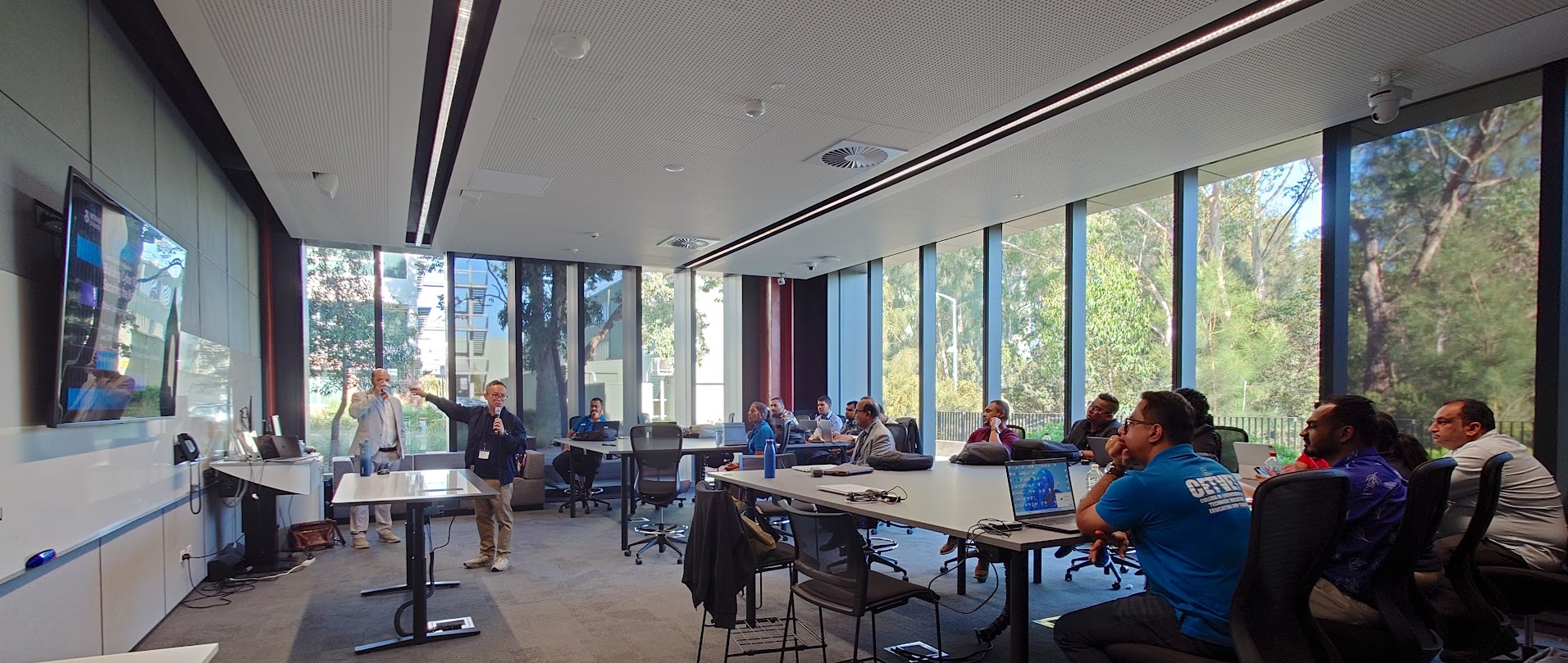
The workshop series brought together Fiji’s three universities, international academics, and global industry leaders
The Fiji National University (FNU) has reinforced its leadership in cybersecurity and digital resilience following high-level engagements at the Building Cyber Resilience in Fiji: Securing the Nation’s Digital Future workshop series hosted at Monash University in Melbourne, Australia.
Led by the Head of School for Mathematics and Computing Sciences at Fiji National University’s College of Engineering and Technical, Vocational Education and Training (CETVET), Mr Vishal Sharma, the FNU delegation showcased the University’s growing leadership in cybersecurity education, postgraduate training, and applied research.
Head of School for Mathematics and Computing Sciences, Mr Vishal Sharma, presenting at the workshop
Their presentation positioned Fiji not simply as a participant in global cybersecurity discussions, but as a proactive and strategic contributor shaping the digital resilience agenda.
For Fiji, as a Small Island Developing State, cyber resilience is no longer optional. It is national security.
“Cybersecurity is not just an IT issue, it underpins banking, telecommunications, e-government services, disaster response and public trust,” Mr Sharma said.
“For Fiji, resilience means the ability to anticipate, withstand, respond to and recover from cyber threats while maintaining essential services.”
The workshop series brought together Fiji’s three universities, international academics, and global industry leaders to examine cybersecurity governance frameworks, AI security, digital forensics, trusted fintech systems, blockchain privacy, and post-quantum cryptography.
Discussions focused on emerging AI-driven threats such as deepfake-enabled fraud, automated phishing, AI-powered cyberattacks, and misinformation campaigns, risks that could significantly impact financial systems and democratic processes if left unaddressed.
FNU highlighted its Postgraduate Diploma in Cybersecurity — with its first cohort expected to graduate in 2026, as a major step toward closing Fiji’s cybersecurity skills gap. The University also announced plans to embed a dedicated AI security unit in its next programme review cycle, ensuring graduates are prepared for both traditional and AI-driven threats.
The engagement further opened doors for joint research projects, PhD co-supervision, curriculum enhancement and potential international funding collaborations. Strategic discussions also explored establishing a collaborative Cybersecurity Society for Fiji, led by local universities, to strengthen national coordination and policy support.
Industry consultations with Telstra and KPMG provided practical insights into real-world cyber defence and risk management, reinforcing FNU’s industry-aligned approach.
This collaboration directly supports Fiji’s National Development Plan objective of building a secure and resilient digital economy, while advancing FNU’s Strategic Plan commitment to strengthening digital capability, applied research and industry-ready graduates.