The saying “Age is no barrier to education” came alive today as the oldest graduate, 82-year-old Losana Dioi, and the youngest, 16-year-old Manoa Tuinaocau, stood proudly among 365 graduates of the Regional and Rural Maritime Technical and Vocational Education and Training (RRMTVET) programme at the Fiji National University’s (FNU) Naiyaca Campus in Labasa.
Tuinaocau, the youngest graduate, completed a Certificate in Domestic Electrical Installation, while Dioi, the oldest, graduated with a Certificate in Floriculture.
In total, 114 female and 251 male graduates successfully completed 14 short courses ranging from Domestic Electrical Installation and Plumbing to Floriculture, Boat Repair, Small Business, Cookery and Baking. These practical qualifications are aimed at strengthening livelihoods, supporting self-employment and building resilient communities across the Northern Division.
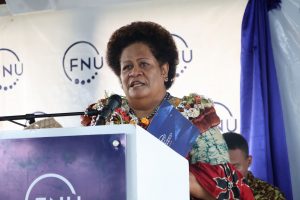
FNU Vice-Chancellor, Unaisi Nabobo-Baba shares her remarks during the RRMTVET graduation at FNU’s Naiyaca Campus in Labasa.
Congratulating the graduates, FNU Vice-Chancellor, Unaisi Nabobo-Baba, said the graduation marked a significant contribution to the Government’s Na Vualiku initiative — a vision to uplift and revitalise communities in the Northern Division — with FNU standing proudly as a committed partner.
“Through continued outreach training, industry partnerships and community-based programmes, we will ensure that skills development remains at the heart of Northern growth,” Professor Nabobo-Baba said.
“Today is more than a graduation ceremony, it is a declaration that the North is rising, that our communities are capable, and that when opportunity meets determination, transformation happens.”
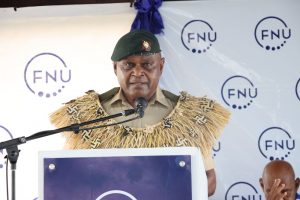
Chief Guest Major Penasio Valeca Mamau from the Republic of Fiji Military Forces addressed the graduates at FNU’s Naiyaca Campus in Labasa.
The Chief Guest Major Penasio Valeca Mamau from the Republic of Fiji Military Forces reminded graduates that skills development goes far beyond securing employment.
“It is about dignity. It is about independence. It is about reducing reliance and increasing capability,” Major Mamau said.
He highlighted that skills training is especially critical in the Northern Division due to geographic distance, limited access to formal employment, the impacts of climate change on agriculture and livelihoods, and the continued movement of young people to urban centres.
“Initiatives like the FNU’s RRMTVET programme are so critical. FNU’s National Training and Productivity Centre takes training to the people because they recognise that talent exists everywhere so opportunity must follow,” he said.
“When a young person gains certification in electrical installation, plumbing, boat repair or small business, that skill stays in the community. It strengthens the village. It creates income. It builds confidence. It keeps families together.”
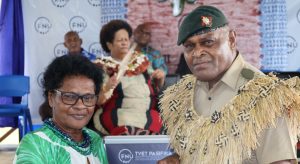
82-year-old Losana Dioi was the oldest graduate under the RRMTVET programme at FNU’S Naiyaca Campus in Labasa.
For Losana Dioi, who hails from Nasekula in Labasa, returning to the classroom after retirement was a personal fulfilment rather than a challenge saying “I have always loved learning. Even after I retired, I did not want to stop. I wanted to learn something new.”
Far from seeing her age as a limitation, Dioi revealed her plans saying, “I have sights set on opening my own flower arrangement business, using all the knowledge and hands on skills I acquired from the training.”
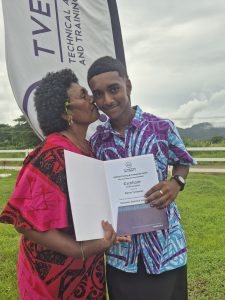
16-year-old Manoa Tuinaocau, stood proudly as the youngest graduate under the RRMTVET programme.
Meanwhile, Tuinaocau’s journey into trade was driven by a long-standing passion. Having left high school halfway through his studies, he said trade work had always fascinated him since childhood.
“Trade is something I enjoy, and I’m proud that I followed my passion. I have seen how people carry out electrical work, and I hope to learn more from short courses as such and become a qualified electrician,” he said.
As graduates celebrated their achievements, the ceremony stood as a powerful reminder that education, when made accessible, can transform lives at any stage — strengthening individuals, families and communities across Fiji’s North.
Ends