
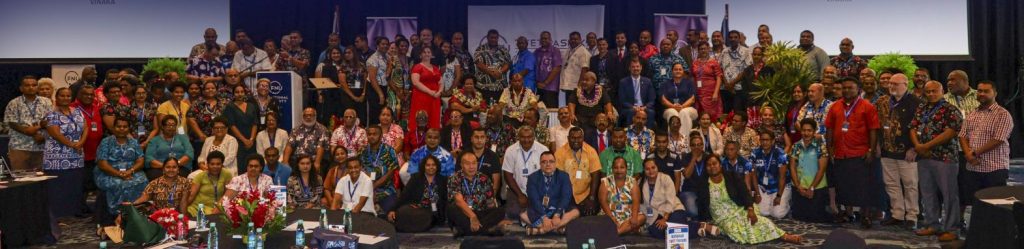
The Minister for Youth and Sports, Honourable Jese Saukuru (sitting first from right with garland) next to the Chief Guest, Ratu Luke Dawai, FNU Vice-Chancellor, Professor Unaisi Nabobo-Baba and participants during the 2026 FNU National TVET Forum in Nadi.
The Fiji National University (FNU) hosted its fourth National TVET (Technical and Vocational Education and Training) Forum at Nadi’s prestigious Sofitel Fiji Resort and Spa on Friday.
The theme of this Forum was ‘Addressing the skills needs of Fiji’.
The Forum brought together more than 120 members from the FNU Senior Leadership Team, and industry experts, representatives from the private and public sectors, as well as FNU staff and students. It created an important platform for collaboration and address the skills needs of Fiji.
Minister for Youth and Sports, Honourable Jese Saukuru who was also present, highlighted that the Ministry’s main goal was to empower every youth in Fiji.
“Especially those who may have dropped out of formal education to realise their dreams and reach their full potential. I am truly grateful to the Fiji National University for their steadfast support in this journey, their partnership has made a real difference in the lives of many young people in Fiji,” said Honourable Saukuru.
The Chief Guest, Ratu Luke Dawai shared that events such as the 2026 FNU National TVET Forum demonstrated the University’s strong commitment to strengthening skills development and building a capable workforce that met the needs of Fiji and the Pacific region.
Ratu Luke Dawai is the younger brother of the Na Momo na Tui Nadi, Ratu Vuniyani Navuniuci.
He also commended the FNU for its foresight in creating a platform where educators, policymakers, industry leaders, and international partners could come together to share knowledge, experiences, and ideas.
“The fact that we are now hosting this Forum annually shows our collective recognition that skills development is not a one-time discussion. It requires continuous dialogue, collaboration, and action. It requires commitment from all sectors of society,” said Ratu Dawai.
“The participation of partners such as TAFE Queensland from Australia and other international institutions reflects the global importance of TVET and the shared responsibility we have in preparing our workforce for an increasingly interconnected world.”
He said addressing the skills needs of Fiji required us to ask important questions.

Participants at the 2026 FNU National TVET Forum in Nadi.
“Are our training programmes aligned with industry demands? Are we preparing our young people for the jobs of tomorrow? Are we creating opportunities for those in rural and maritime communities to access quality training? And most importantly, are we working together as partners to ensure sustainable solutions?” he added.
“We must also ensure that TVET continues to promote inclusiveness, allowing equal opportunities for women, persons with disabilities, and individuals from rural and marginalised communities. When we invest in inclusive skills development, we strengthen our entire nation.”
FNU Vice-Chancellor, Professor Unaisi Nabobo-Baba, highlighted that FNU’s work was guided by FNU’s Strategic Plan 2024–2026, which served as the roadmap toward delivering high-quality, relevant, and transformative education that supported Fiji’s development priorities and aligned closely with the national vision outlined in Fiji’s 20-Year National Development Plan 2017–2036.
She said FNU’s contributions to Fiji underscore the vital role TVET plays as the backbone of Fiji’s key industries.
“Between 2019 and 2024, FNU graduated more than 69,000 TVET learners, including over 60,000 from formal programmes and short courses, and more than 8,500 from community-based rural training initiatives,” said Professor Nabobo-Baba.
“By the end of 2025, we were projected to surpass 100,000 skilled workers trained through our programmes. Looking ahead, we anticipate producing more than 200,000 TVET graduates by 2030. These figures represent more than statistics — they represent livelihoods transformed, families uplifted, and communities strengthened.
“Over the past five years alone, FNU has trained more than 11,000 graduates in tourism and hospitality, nearly 10,000 in commerce and executive management, close to 7,000 in construction trades, more than 5,600 in electrical and electronics, over 3,300 in information technology, and more than 18,000 in automotive engineering.”