
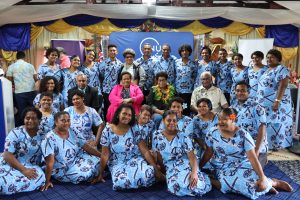
Fundamental Food & Beverage students after their graduation at Sila Village in Cuvu, Nadroga
A total of 365 students graduated today from the Fiji National University’s (FNU) National Training and Productivity Centre’s (NTPC) Community-Based Non-Formal Education Programme at Sila Village in Cuvu, Nadroga, with women accounting for 188 of the graduates.
The strong representation of women highlights their growing participation in technical and vocational education and training (TVET) and the importance of bringing practical skills training closer to communities across Fiji.
The Chief Guest, Chancellor and Chair of the FNU Council, Dr Adi Alisi Talatoka Vudiniabola, said she was pleased to see so many women among the graduates.
“As women, we carry many responsibilities within our homes and communities. Often, women put the needs of everyone else before their own development. So, when I see this many women taking the opportunity to learn, gain a skill and complete their training, I am very encouraged,” Dr Vudiniabola said.
The Chancellor and Chair of the FNU Council added that she hopes the women graduating today will encourage other women in our villages.
“I hope women who are graduating today, will encourage other women in our villages who may still be wondering whether they can do the same, and the answer is yes,” she reiterated.
Dr Vudiniabola said providing people with opportunities to gain skills, was important to the wellbeing and development of communities.
“We want our young people to have opportunities. We want our families to be able to support themselves. We want our women to have choices, and we want our communities to have people with the skills and confidence to contribute to their own development,” Dr Vudiniabola stated.
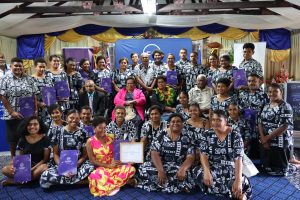
Cookery students after their graduation at Sila Village in Cuvu, Nadroga
FNU Vice-Chancellor Professor Unaisi Nabobo-Baba said learning should remain accessible to people at every stage of life.
“To see more women represented among our graduates is something we should celebrate. It shows that our women are taking up opportunities to learn new skills, improve their livelihoods and contribute even more strongly to their families and communities,” said the Vice-Chancellor.
The graduating cohort also reflected the value of lifelong learning, with students ranging in age from 16 to 69.
“Our youngest graduates are 16 years old and for this graduation there are five of them, and the oldest is 69 years old. Different generations, different life experiences and probably very different reasons for joining the programme, but they are here for the same reason, they chose to learn,” Professor Nabobo-Baba said.
Among the youngest graduates was 16-year-old Jonah Veibose, who completed training in joinery.
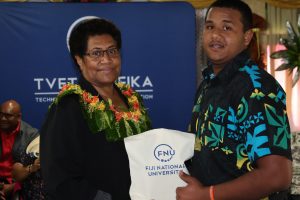
Chief Guest Chancellor and Chair of the FNU Council Dr Adi Alisi Vudiniabola with Jonah Veibose at today’s graduation held at Sila Village in Cuvu, Nadroga
Jonah said the programme gave him an opportunity to develop practical skills and strengthened his interest in pursuing further studies at FNU.
“I want to take up joinery when I enter tertiary and when the opportunity came, I took it. Now, I can confidently say that I know how to make a lot of things in the two weeks.”
“I am actually looking forward to attending FNU after this programme because I know I have a lot to learn and I want to learn as much as I can,” Jonah said.
For the graduates, the ceremony marks more than the completion of a course. It is a step towards new skills, greater confidence and opportunities for the future.