
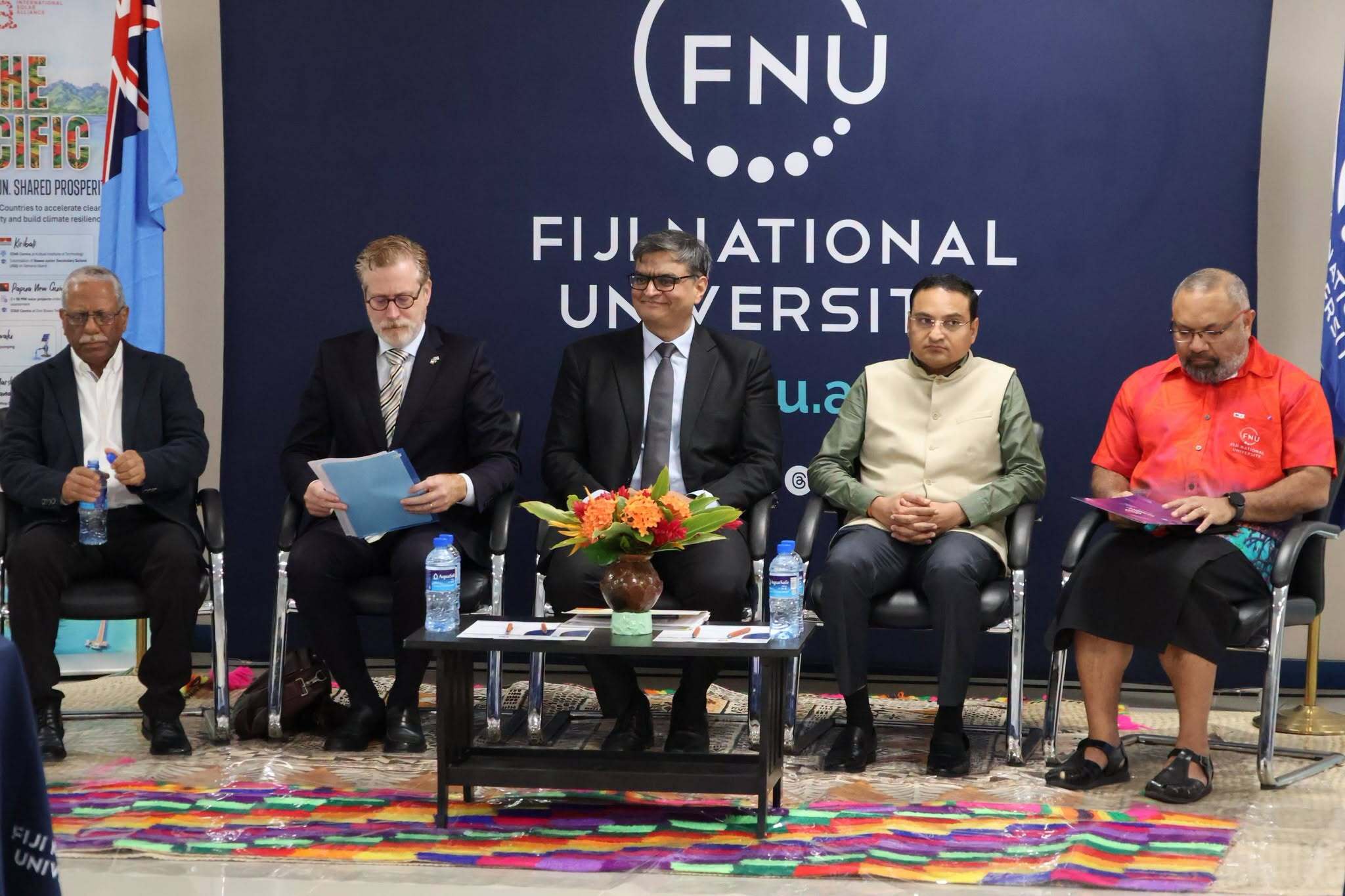
Dean CETVET, Prof. Atul Raturi, Charge d’Affaires France, Mr Benjamin Delannoy, Director General ISA, Mr Ashish Khanna, High Commissioner of India to Fiji, H.E Suneet Mehta, FNU’s APVC Research, Dr Donald Wilson
The Fiji National University (FNU) welcomed International Solar Alliance (ISA) Director General, Mr Ashish Khanna, to its Derrick Campus this week as the two organisations continue to work together to strengthen solar energy skills, research and innovation in Fiji and the Pacific.
Mr Khanna’s visit provided an opportunity for FNU and ISA to discuss the progress of the Solar Technology Application Resource Centre (STAR-C) and explore how the Centre can contribute to renewable energy development in Fiji and across the region.
Acting Pro-Vice-Chancellor Research and Innovation, Dr Donald Wilson, said the visit was an important opportunity to strengthen the partnership and ensure that FNU’s education and research contribute to practical solutions for Fiji and the Pacific.
“At the Fiji National University, we believe universities must be more than centres of learning. They must be centres of transformation. Our success is measured not only by the graduates we produce, but by the partnerships we build, the solutions we create and the lives we impact,” Dr Wilson said.
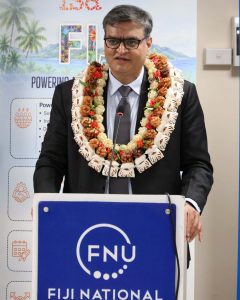
Director General, International Solar Alliance, Ashish Khanna
He said STAR-C was an important part of FNU’s commitment to supporting Fiji’s transition to cleaner and more sustainable energy.
“STAR-C is an investment in people. It is an investment in the engineer who will design Fiji’s future energy systems, the researcher developing renewable energy solutions for our islands, and the technician who will help expand clean energy access across our communities,” Dr Wilson said.
Mr Khanna said the partnership had the potential to benefit countries across the Pacific, with ISA’s vision for STAR-C extending beyond Fiji.
“Our desire is for STAR-C at the Fiji National University to become a regional centre because it is difficult for many small island nations to develop this level of capacity on their own. Some do not even have a university,” Mr Khanna said.
He said the Centre could provide technical support to utilities, assist with renewable energy projects and support regulatory development, while creating opportunities for Pacific Island countries to share knowledge and expertise.
“It is about fostering regional collaboration across the Pacific and creating a shared platform that benefits all our island nations,” he said.
“Ultimately, our vision goes beyond training. It is about building long-term capability, not just capacity, strengthening institutions and supporting sustainable development across the Blue Pacific.”
The visit builds on the Memorandum of Understanding (MoU) signed between FNU and ISA in September 2025 at the Department of Public Works.
The MoU provided the foundation for the establishment of STAR-C, which will support training, knowledge exchange, technical capacity building, research and innovation in solar energy.
Mr Khanna also highlighted the opportunity for Fiji to reduce its reliance on imported diesel by increasing investment in solar energy and energy storage.
For FNU, STAR-C provides a practical link between education, research and Fiji’s transition to cleaner energy.
Through the Centre, students and professionals will have opportunities to develop practical skills, while researchers, industry and international partners can work together on renewable energy solutions that respond to the needs of Pacific communities.
The initiative is aligned with FNU’s Strategic Plan 2024–2026, which identifies renewable energy, climate resilience, innovation and human capital development as important areas for sustainable growth. It also supports the University’s contribution to the Sustainable Development Goals, particularly SDGs 4, 7, 9, 13 and 17.
As Fiji and its Pacific neighbours prepare for COP31 and continue to respond to climate change and growing energy needs, FNU and ISA see STAR-C as an important step towards building stronger solar energy skills, knowledge and expertise in the region.