
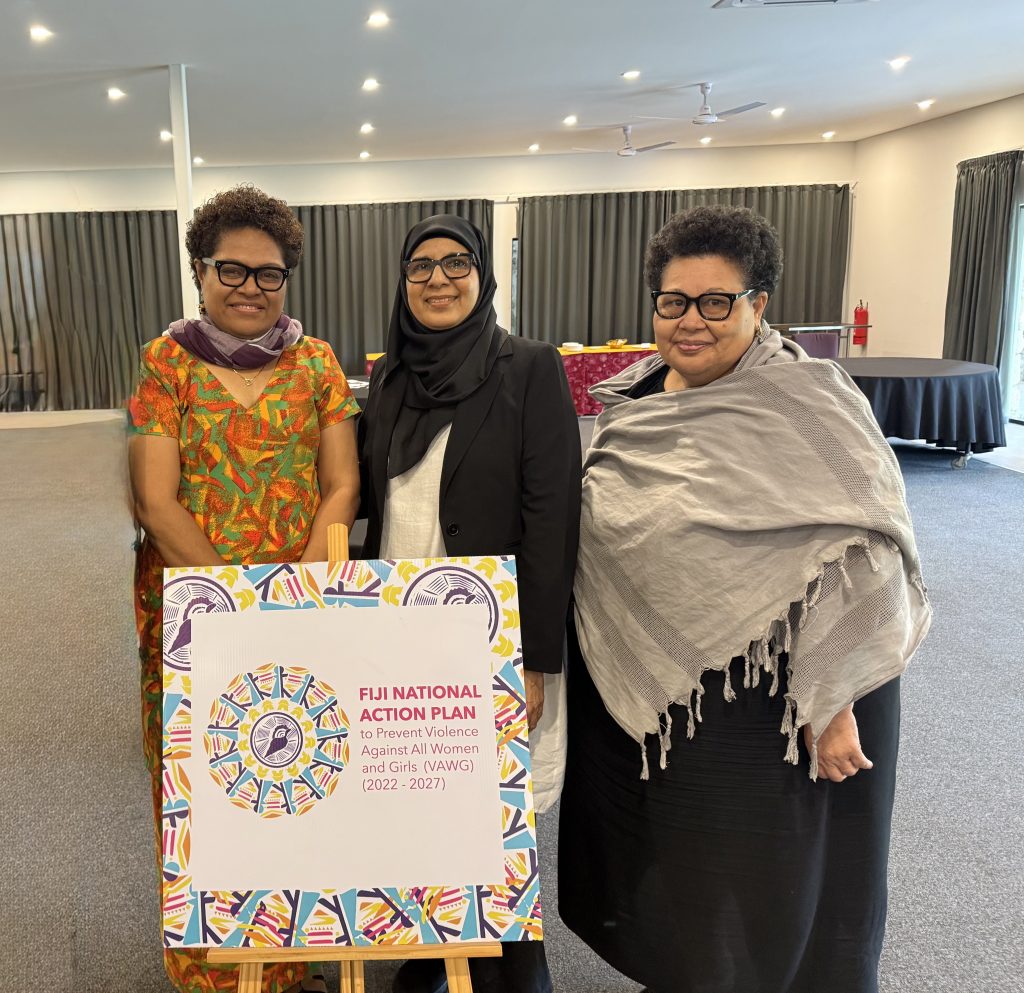
From left to right; Ms Maopa Saumi, Dr Jasmine Hussain and Ms Litia Makutu.
The Fiji National University (FNU) is looking at how it can strengthen its role in preventing violence against women and girls through education, research, student engagement and community work.
This was highlighted during the National Action Plan for Prevention of Violence Against Women and Girls (NAP PVAWG) Monitoring, Evaluation and Learning (MEL) Training and Consultation held from 23 to 25 September 2026 at the Novotel Hotel, Lami, Suva.
The three-day consultation was organised by the Fiji NAP PVAWG Coordination and Implementation Unit of the Ministry of Women, Children and Social Protection. It brought together key stakeholders to strengthen understanding of gender-based violence (GBV) prevention, review progress under the NAP, validate the NAP Theory of Change and discuss how progress and impact could be better measured.
Representing FNU were Dr Jasmine Hussain, Assistant Professor – Social Science and Chairperson of the FNU GEDSI Working Committee, Ms Litia Makutu, Head of the Department of Public Health, and Ms Maopa Saumi, Assistant Lecturer – Education.
The training used a whole-of-government, strengths-based, survivor-centred and rights-based approach. Participants discussed GBV prevention, gender equality, respectful relationships and the importance of preventing violence before it happens.
For Dr Hussain, the consultation was a useful opportunity for FNU to explore opportunities to contribute to the national effort.
“The workshop provided an excellent platform for networking, knowledge exchange and collaboration. It also helped us look at how universities can contribute to preventing violence through education, research, student engagement and institutional action,” she said.
Participants also got insights from the NAP Mid-Term Review and Theory of Change to ensure planned interventions remain relevant and effective. The discussions highlighted the need for government agencies, educational institutions, development partners and communities to work together in the prevention of violence against women and girls.
A key part of the consultation focused on Monitoring, Evaluation and Learning (MEL). Participants looked at outcome indicators, how to measure success, and how data can be used to track progress and improve decision-making.
“The MEL sessions were particularly useful in helping us understand how we can measure whether our interventions are making a difference. Having clear indicators and using evidence to guide our decisions will be important as we move forward with the implementation of the NAP,” Dr Hussain added.
At the end of the consultation, Team FNU submitted a draft FNU workplan brief to MEL Manager Mr Sakeo Moce and his team for feedback.
Dr Hussain said FNU would need to take a whole-of-institution approach in its contribution to the implementation of the NAP PVAWG.
“It is envisaged that FNU, together with universities and technical institutes, will embrace veimataki leadership, veiwekani and the shared spirit of solosolevaki to incorporate NAP PVAWG strategies across our institutions,” she further stated.
Under the NAP PVAWG 2023–2028, universities and technical and vocational institutions are expected to contribute to prevention through teaching, research, outreach and student engagement.
This includes strengthening life-skills and violence prevention content, empowering students as agents of change, improving reporting and referral mechanisms, strengthening institutional policies and procedures, building the capacity of staff and campus security, and supporting research, data collection and monitoring.
For FNU, this means looking at how its teaching, research, student support and community work can contribute to preventing violence against women and girls.
“Universities have an important role to play because we are not only educating students,” Dr Hussain said. “We are also helping shape the attitudes, relationships and values that students take with them into their families, workplaces and communities,” Dr Hussain explained.
She reiterated that FNU would need to continue strengthening awareness and prevention programmes, reviewing relevant institutional policies and ensuring that effective reporting and referral mechanisms are in place.
“Regular training for staff and students, supported by research and ongoing monitoring, will help us understand what is working and where more effort is needed,” said Dr Hussain.
FNU’s participation in the consultation is part of the University’s ongoing work to support gender equality and promote safer, more inclusive learning environments.
Through its teaching, research, student engagement and community work, FNU will continue to look at practical ways it can contribute to the NAP PVAWG and support efforts to prevent violence against women and girls in Fiji.