
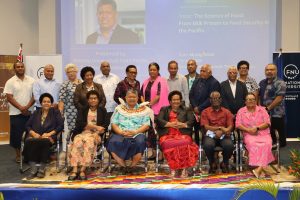
Internationally renowned Pacific academic Professor Palatasa (Tasa) Havea with the Fiji National University’s Senior Leadership Team
The Fiji National University (FNU) today hosted a seminar by internationally renowned Pacific academic Professor Palatasa (Tasa) Havea, on the theme “The Science of Food: From Milk Protein to Food Security in the Pacific.”
The seminar, held at the College of Business, Hospitality and Tourism Studies (CBHTS) Lecture Theatre, brought together academics, researchers, staff and students for knowledge sharing and a panel discussion on the role of science, innovation and indigenous knowledge in strengthening food systems across the Pacific.
FNU Vice-Chancellor Professor Unaisi Nabobo-Baba said Professor Havea’s journey as a scientist, academic leader and Dean serves as a reminder, that the true purpose of higher education is not only to generate knowledge, but to apply knowledge to serve our communities and society.
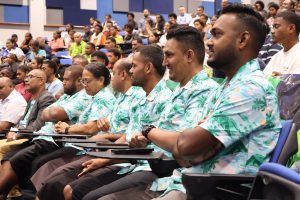
Fiji National University’s College of Agriculture, Fisheries and Forestry staff at the seminar which was held at the Nasinu Campus
“Science finds its highest purpose when it improves lives, strengthens communities and helps shape a more sustainable future. For Pacific Island countries, food security is increasingly shaped by climate change, nutrition transitions, dependence on imported foods, pressure on fisheries and agricultural systems, and the urgent need for practical technologies and stronger local production.”
“These challenges cannot be addressed by one discipline, institution or sector alone. They require the integration of science and indigenous knowledge, research and community experience, innovation and responsible leadership,” Professor Nabobo-Baba said.
The Vice-Chancellor highlighted FNU’s role as Fiji’s national university and its responsibility to contribute to national and regional development through collaboration, research and innovation.
“As Fiji’s national university, FNU has a clear responsibility to serve as a tool, agency and enabler of national and regional development. Our colleges must work across disciplines, linking agriculture, fisheries and forestry with health and nutrition, engineering and technology with food processing, business and hospitality with value chains and entrepreneurship, and education, culture and policy with community transformation.”
“Our teaching must connect laboratory knowledge with field realities, and our research must lead to solutions that are locally grounded, scientifically informed and regionally connected,” she said.
The Vice-Chancellor encouraged students and emerging researchers to embrace opportunities for innovation and explore how knowledge gained through discussions such as the seminar can contribute to new courses, research initiatives, community programmes, policy development, industry partnerships and postgraduate study.
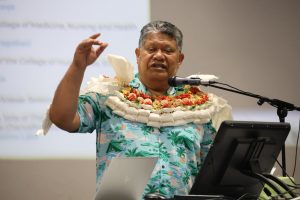
Internationally renowned Pacific academic Professor Palatasa (Tasa) Havea
Professor Havea emphasised the importance of food security and the need for continuous innovation in addressing challenges facing Pacific communities.
“Innovation is seeing what nobody else is seeing. Innovation is thinking what nobody else is thinking. Food security should be a top priority for every country. We have the land, the people, the knowledge, and the rich cultural practices to support food production, yet we continue to face challenges with food insecurity. We must be inspired to grow our own food, even in our backyards, and enjoy fresh produce throughout the year. By returning to our own food-growing traditions, we can strengthen our communities and improve food security,” Professor Havea said.
In addition, he highlighted the value of ancestral knowledge and its relationship with modern science, noting that traditional knowledge systems provide important insights that can complement scientific research and technological advancement.
Professor Havea’s visit to FNU reflects the University’s continued commitment to strengthening regional partnerships, promoting knowledge exchange and creating opportunities for collaboration in areas critical to Pacific development.