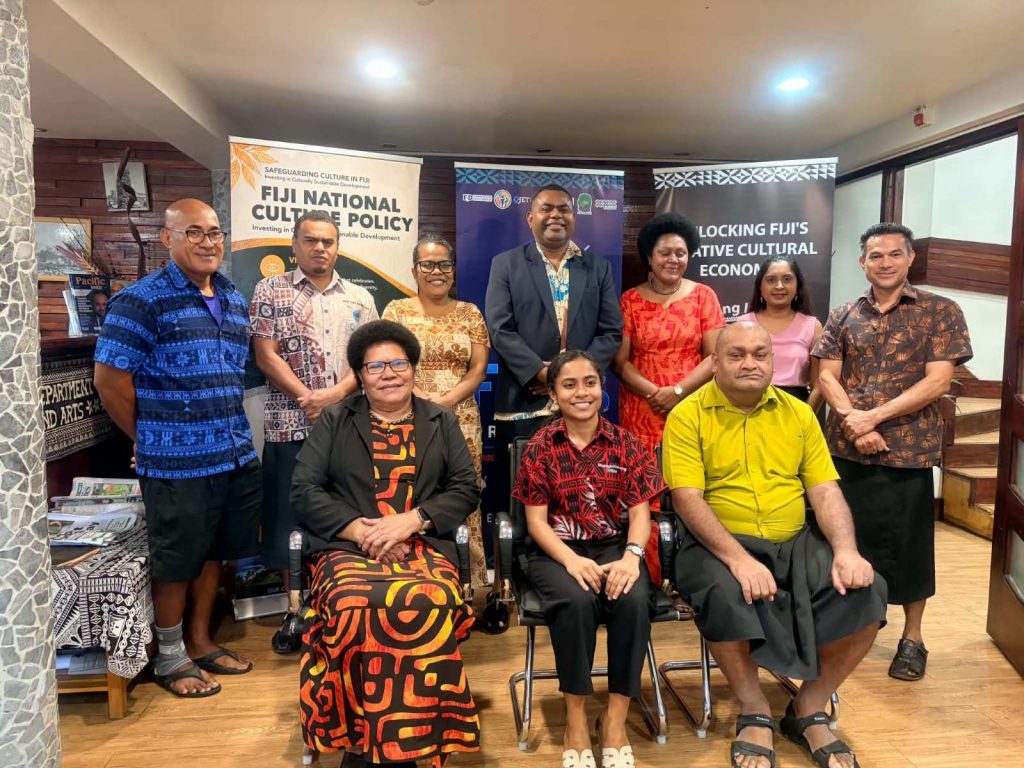
Assistant Professor Dr Varanisese Tagimaucia (standing, third from left) together with the FNU delegation and key representatives from the Ministry of Multi-Ethnic Affairs, Culture, Heritage and Arts, following discussions in Suva last month.
“Our culture, language, heritage and traditional knowledge should not only be something we preserve; they should also be part of how we educate, conduct research and contribute to national development.”
This was the message shared by Assistant Professor Dr Varanisese Tagimaucia, Head of the School of Education at the Fiji National University’s (FNU) College of Humanities, Education and Law (CHEL), following a meeting between FNU and the Ministry of Multi-Ethnic Affairs, Culture, Heritage and Arts, held in Suva last month.
Dr Tagimaucia said the outcome of the meeting was positive, giving FNU an opportunity to understand the Ministry’s priorities and identify where FNU’s expertise could contribute.
“Some of the key areas discussed included research and publications, cultural education, capacity building, curriculum and resource development, the preservation of Indigenous knowledge and languages, creative arts and industries, and the development of micro-credentials and recognition pathways for artists, artisans and traditional knowledge holders. We also discussed the possibility of formalising the partnership through a Memorandum of Understanding (MOU).”
“What was important to us was that the discussion was not only about what FNU can offer, but also about identifying areas of mutual interest that address national priorities. This provides a strong foundation for a more structured and sustainable partnership between FNU and the Ministry,” she said.
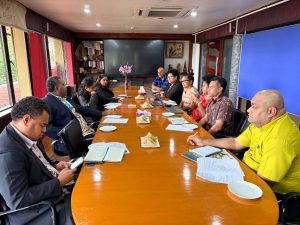
The FNU delegation in discussion with key representatives from the Ministry of Multi-Ethnic Affairs, Culture, Heritage and Arts, in Suva last month.
Dr Tagimaucia added that the engagement also opened opportunities for the University particularly in the areas of education, languages, humanities and social sciences, creative arts, law, TVET and research.
“From an education perspective, there is significant potential to collaborate on teacher preparation, professional development, curriculum development and the creation of culturally appropriate teaching and learning resources.
There are also strong research opportunities in areas such as mother-tongue education, Indigenous and culturally responsive pedagogies, cultural well-being, traditional knowledge, climate change and cultural loss, creative industries, traditional games and physical activity, archaeology and heritage, and cultural law and policy.”
“For our students and staff, the value lies in creating opportunities for applied research, community engagement, resource development, and learning grounded in Fiji’s cultural context. Ultimately, we would like the partnership to contribute to preserving knowledge while also creating opportunities for that knowledge to remain relevant, valued and passed on to future generations,” Dr Tagimaucia elaborated.
The discussions also explored the proposed establishment of a Centre for Fijian and Pacific Studies at FNU, which could serve as a platform to support research, preserve Indigenous knowledge and promote culturally responsive teaching and learning.
Dr Tagimaucia also stated that the FNU now looks forward to continuing its dialogue with the Ministry and translating the ideas identified into practical initiatives that will benefit students, staff and communities across Fiji.
The FNU delegation also included CHEL Associate Dean TVET Mr Jerry Wong, Lecturer in Education Ms Katarina Ruru, Assistant Professor in Education Dr Kasanita Nayasi and Head of the Department of Creative Arts Mr Joseph Lavulo, who met with key representatives from the Ministry to discuss areas of mutual collaboration.