The Fiji National University (FNU) and the Ministry of Fisheries and Forestry are envisioning the evolution of their renewed partnership into a practical ‘Blue Hub’ for applied learning and innovation, bringing together students, government, scientists, researchers, communities, farmers, industry and development partners to address national priorities and translate knowledge into measurable outcomes.
The vision was outlined yesterday, during the signing of a Memorandum of Understanding (MoU) between FNU and the Ministry of Fisheries and Forestry at the FNU Nasinu Campus.
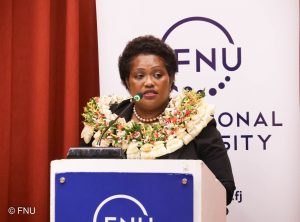
Minister for Fisheries and Forestry, Honourable Alitia Bainivalu shared her keynote address
The Minister for Fisheries and Forestry, Honourable Alitia Bainivalu, said the signing marked the renewal of a relationship between two institutions with complementary national responsibilities.
“The MOU gives us a five-year platform to connect and exchange ideas and expertise, fisheries-related training, the identification of research and operational gaps, industrial attachments for FNU fisheries students, joint research and development, the sharing of appropriate research and training facilities, publication of research outcomes, workforce capacity building and, where needed, co-supervision of postgraduate students,” Honourable Bainivalu said.
The Honourable Minister highlighted that the partnership was important and timely, as the challenges facing Fiji’s fisheries and aquaculture sectors become increasingly complex.
“We are dealing with food and nutrition security, climate variability, aquatic biosecurity, changing coastal ecosystems, market expectations, economic shocks, illegal, unregulated, and unreported (IUU) fishing, and the need to create meaningful opportunities for young people. No single institution can address all of these challenges in isolation. Strong public policy needs strong science. Strong science needs access to real problems and real data. And our students need opportunities to learn in environments where knowledge must work in practice,” she stated.
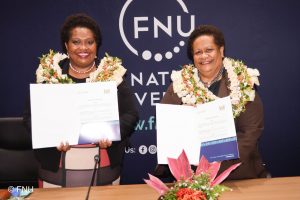
FNU Vice-Chancellor, Professor Unaisi Nabobo-Baba and the Minister for Fisheries and Forestry, Honourable Alitia Bainivalu signed the MoU.
The Minister further added that the Ministry could become an extended classroom through hatcheries, research stations, laboratories, farms, coastal communities, field programmes, regulatory processes, compliance activities and fisheries development projects.
“The University can become an extended knowledge partner – bringing academic expertise, research design, analytical capability, training resources, innovation, and the fresh perspective of students and young researchers. This is exactly the type of partnership Fiji needs: one that links education to national development, research to operational need, and learning to service,” she emphasised.
Honourable Bainivalu also stated that the partnership aligned with the broader direction of Fiji’s Aquaculture Development Plan 2024–2028 and the Fiji Blue Economy Framework 2025–2035, which emphasises sustainable ocean-based development, resilience, science, innovation and responsible stewardship.
In addition, the partnership also provide a platform to contribute to the Sustainable Development Goals, particularly those relating to food security, quality education, decent work, innovation, climate action, life below water and partnerships.
“The Ministry envisions this partnership evolving into a practical ‘Blue Hub’ for applied learning and innovation – a connected platform where students, government, scientists and technical officers, researchers, communities, farmers, industry, and development partners can collaborate on priority problems and translate knowledge into measurable outcomes,” the Minister elaborated.
Priority areas for collaboration may progressively include offshore fisheries, coastal and inland fisheries, aquaculture development and other mutually agreed areas within the scope of the MoU.
Honourable Bainivalu said the partnership could also help young people view fisheries and aquaculture as areas of enterprise and national opportunity, while ensuring communities remained at the centre of development.
“The Ministry and the University can help young people see fisheries and aquaculture not only as fields of study, but as fields of enterprise and national opportunity. At the same time, we must keep our communities at the center. Fisheries and aquaculture development succeeds when people understand it, participate in it, and benefit from it. Our research should therefore reach farmers in a practical form. Our training should be understandable to communities. Our technologies should be appropriate to local conditions. And our development programmes should recognise the contribution of women, youth, traditional knowledge holders, and people living in maritime and rural areas,” she explained.
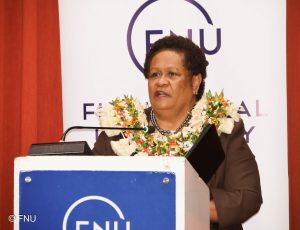
Fiji National University Vice-Chancellor, Professor Unaisi Nabobo-Baba delivered her address.
FNU Vice-Chancellor, Professor Unaisi Nabobo-Baba, said the MoU renewed the University’s commitment to working alongside the Ministry to strengthen Fiji’s position as a Blue Hub for the Pacific.
“We have heard your vision for the blue economy, and we welcome further discussions on the establishment of a new centre jointly owned by FNU and the Ministry that can advance this vision. We are committed to bringing to life the ideas and opportunities you have shared with us today,” Professor Nabobo-Baba said.
The Vice-Chancellor added that the University would also seek the Ministry’s input as it develops its Strategic Plan for 2027–2031.
“As we develop our Strategic Plan for 2027 to 2031, we will share it with the Ministry for your consideration and welcome your advice on areas that could further strengthen the programmes delivered by our College of Agriculture, Fisheries and Forestry,” she stated further.
Professor Nabobo-Baba reiterated that the MoU would also allow FNU to identify practical areas where both institutions could begin delivering tangible outcomes before the end of the year.
“We are hopeful that there will be three key areas we can work on and progress before December this year. These include having our team visit Colo-i-Suva Forest, while also exploring the potential of agriculture and mariculture in Fiji. We could perhaps begin with Navua Aqua Farms, where there has already been significant interest in opportunities for collaboration among the farms,” said Professor Nabobo-Baba.
She also highlighted the importance of expanding collaboration in the Northern Division.
“The Northern Division remains a particular priority for us. For many years, we have continued to strengthen our presence in the North, and we are keen to learn more about the Ministry’s plans for fisheries and forestry in the region. As part of the Government, we are serious about sharing our resources and expertise, while also recognising that when we need experience and wisdom, we will turn to the Ministry and its team,” said said the Vice-Chancellor.
Professor Nabobo-Baba thanked Honourable Bainivalu and the Ministry for their trust and commitment to strengthening the partnership.
“I thank you, Honourable Minister, and the Ministry for your trust and commitment to strengthening this partnership further. We look forward to working even more closely with you. We have already established strong links with the agriculture offices in Suva, and we intend to build the same relationship with the Ministry of Fisheries and Forestry,” she added.
The MoU reinforces FNU and the Ministry’s shared commitment to connecting education, research, innovation and government priorities to support sustainable fisheries and forestry development and create meaningful opportunities for Fiji’s communities and future generations.
The five-year MoU provides a framework for strengthening collaboration in fisheries-related training, research and development, industrial attachments, workforce capacity building, the sharing of research and training facilities, publication of research outcomes, and the co-supervision of postgraduate students.
ENDS