
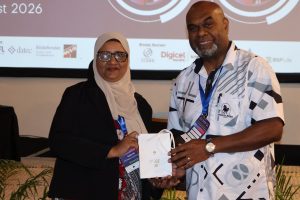
“Artificial intelligence is changing what students can produce, and a Fiji National University (FNU) academic says it should also change how universities teach, learn and assess.”
Assistant Professor in Education, Dr Sofia Shireen Ali, made the call during the panel discussion titled, “Beyond ChatGPT – Reimagining Higher Education in an AI-Driven World”, at the 7th National Conference on Information Technology (NCIT) 2026.
The discussion brought together experts to consider how higher education can respond to the opportunities and challenges created by the rapid development of artificial intelligence.
Organised by FNU’s National Training and Productivity Centre, NCIT 2026 was held under the theme, “From Vanua to Virtual: People, Trust and Technology Driving a Secure, Trusted and Productive Digital Pacific.”
Dr Ali said generative AI can now produce essays, solve problems and provide information within seconds, challenging universities to rethink assessment approaches that have traditionally focused on what students can reproduce.
“AI can generate information, but higher education must develop judgement, values and wisdom,” she said.
For Dr Ali, the issue is not simply about whether students use AI, but what they learn to do with it.
She said higher education must continue to develop critical judgement, ethical reasoning, creativity, problem-solving and the ability to apply knowledge to real situations.
Educators therefore have an important role in helping students understand that having access to information is not the same as understanding it.
Dr Ali said students need to learn how to question information, check whether it is accurate, challenge what they are presented with and use AI responsibly.
“AI should support thinking, not replace thinking,” Dr Ali added.
This changing environment also means universities need to look differently at assessment.
“If AI can generate an essay or lesson plan within seconds, then our assessments must go beyond asking for the final product. We need to assess the learning process,” she further stated.
Dr Ali suggested that students could be asked to explain and defend their decisions, critique AI-generated responses, identify errors or biases, apply knowledge to local case studies or reflect on how they used AI to complete a task.
She also highlighted approaches such as oral presentations, viva or oral defence, practical demonstrations, reflective writing, portfolios, case studies, project work and real-world problem-solving.
These approaches can give students greater opportunities to demonstrate what they understand, how they think and how they apply their knowledge, rather than relying only on a final written product.
But the responsibility does not rest with students alone. Dr Ali said educators also need support to adapt to the changing role of AI in teaching and learning.
She said professional development should go beyond teaching academics how to use AI tools. It should also help educators understand how generative AI works, assess AI-generated information, identify bias and misinformation, verify sources, and consider privacy and ethical issues.
Academics, she said, also need practical support to redesign assessments that continue to encourage critical thinking, creativity and meaningful engagement between students and educators.
Dr Ali further highlighted the importance of aligning AI use with FNU’s Academic Integrity Policy, saying the conversation should not be limited to detecting and punishing inappropriate use.
“Academic integrity should also be educational. Students need to know what responsible practice looks like and why it matters,” Dr Ali highlighted.
She said academics and students need a shared understanding of when AI can be used appropriately, how its use should be acknowledged or disclosed, and how to recognise misinformation, bias and fabricated references.
For Dr Ali, these questions are particularly important in the Pacific. As universities embrace new technologies, she said education must remain connected to local cultures, communities, languages, Indigenous knowledge and Pacific realities.
“At FNU, we are preparing graduates not simply for employment, but to contribute meaningfully to Fiji and the wider Pacific,” she said.
As AI continues to develop, the challenge for higher education is not simply to keep up with the technology. It is to ensure that students remain at the centre of learning, developing the judgement, values, creativity and practical skills they need to use technology responsibly and make a difference in their communities.