
A total of 41 staff and students stepped forward to donate blood last week, marking a significant highlight of the Fiji National University’s (FNU) College of Medicine, Nursing and Health Sciences (CMNHS) Lab Week celebration and reinforcing the life-saving impact of community action.
Held at the Pasifika Campus on Thursday, 23 April 2026, the Blood Donation Drive was organised by the Department of Pathology and Medical Laboratory Sciences (DPMLS) under the Lab Week theme, “Lab Story: To Infinity and Beyond for Our Patients.” The initiative brought together students and staff in a collective effort that has the potential to save at least 123 lives.

FNU’s College of Medicine, Nursing and Health Sciences (CMNHS), Acting Dean, Dr Amelia Turagabeci thanked the donors for their support.
CMNHS Acting Dean, Dr Amelia Turagabeci, commended the donors and organisers, noting that the success of the drive reflected both commitment and leadership within the College. She highlighted that the initiative was led by dedicated staff and Bachelor of Medical Laboratory Science students and supported through the Australia AID-Aspire Grant awarded to Assistant Professor Dr Aruna Devi.
“We are proud to share that 41 donors came forward to give blood, making this initiative a great success with the potential to save many lives,” Dr Turagabeci said.
She emphasised that such initiatives elevate not only the College’s profile but also the visibility and importance of the laboratory profession within the healthcare system.
“Through this week’s activities, our students have demonstrated that laboratory science is the backbone of the health system. You have not only celebrated Lab Week but also raised awareness among those who may not fully understand the critical role laboratories play in patient care,” she added.

Chief guest and Oceania Hospitals Chief Executive Officer, Mr David Qumivutia shared his remarks.
Chief guest and Oceania Hospitals Chief Executive Officer, Mr David Qumivutia, challenged students to pursue excellence beyond their qualifications by embracing resilience, commitment and innovation.
“The qualification you are working towards will open the door for you, but your success depends on the skills you develop along the way,” Mr Qumivutia said.
He underscored the importance of innovation in modern healthcare, urging students to continuously improve systems and processes within laboratory and clinical settings.
“There is a pressing need to modernise and realign our health systems. Innovation is not optional—it is necessary for progress and better patient outcomes,” he stated.
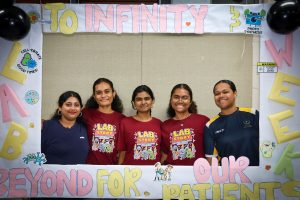
Students at the Lab week celebration at CMNHS.
He also highlighted the growing importance of data in healthcare, calling on future professionals to translate research findings into meaningful information that can influence policy and resource allocation.
“Make use of every opportunity. When you gather data through research, ensure it is articulated in a way that informs decision-makers and strengthens the health system,” he said.
The successful blood drive and Lab Week activities underscore CMNHS’s commitment to community engagement, professional excellence and advancing healthcare outcomes in Fiji.
ENDS